Being Rejected by a Peer Group Can Negatively Influence One's Self-esteem.
Chapter iii. The Self
The Feeling Self: Self-Esteem
- Ascertain self-esteem and explain how it is measured by social psychologists.
- Explore findings indicating diverseness in self-esteem in relation to culture, gender, and historic period.
- Provide examples of means that people attempt to increase and maintain their self-esteem.
- Outline the benefits of having high cocky-esteem.
- Review the limits of cocky-esteem, with a focus on the negative aspects of narcissism.
As we have noted in our discussions of the self-concept, our sense of self is partly adamant by our knowledge. However, our view of ourselves is as well the production of our affect, in other words how we feel about ourselves. Just equally we explored in Chapter 2, cognition and bear on are inextricably linked. For example, self-discrepancy theory highlights how we feel distress when we perceive a gap between our actual and ideal selves. We will now examine this feeling cocky, starting with perchance its about heavily researched aspect, self-esteem.
Self-Esteem
Self-esteem refers to the positive (high self-esteem) or negative (low cocky-esteem) feelings that we accept most ourselves. We feel the positive feelings of high self-esteem when nosotros believe that we are skillful and worthy and that others view united states of america positively. We experience the negative feelings of low cocky-esteem when we believe that we are inadequate and less worthy than others.
Our self-esteem is adamant by many factors, including how well nosotros view our own performance and advent, and how satisfied we are with our relationships with other people (Tafarodi & Swann, 1995). Self-esteem is in part a trait that is stable over time, with some people having relatively high self-esteem and others having lower self-esteem. Just self-esteem is as well a state that varies solar day to mean solar day and even hour to hour. When we accept succeeded at an important job, when we take done something that we think is useful or important, or when we feel that nosotros are accustomed and valued by others, our self-concept will contain many positive thoughts and we will therefore accept loftier cocky-esteem. When we have failed, washed something harmful, or experience that we have been ignored or criticized, the negative aspects of the self-concept are more accessible and we experience low cocky-esteem.
Self-esteem can be measured using both explicit and implicit measures, and both approaches find that most people tend to view themselves positively. Ane mutual explicit self-report measure of cocky-esteem is the Rosenberg Self-Esteem Scale (Figure 3.8). Higher scores on the scale indicate higher self-esteem.
Figure 3.8 The Rosenberg Self-Esteem Scale
Delight charge per unit yourself on the following items past writing a number in the blank before each statement, where y'all
one = Strongly Disagree 2 = Disagree 3 = Concord iv = Strongly Agree
- _____I feel that I'm a person of worth, at least on any equal base with others.
- _____I feel that I take a number of good qualities.
- _____All in all, I am inclined to recollect that I am a failure (R).
- _____I am able to exercise things also every bit other people.
- _____I feel I do not take much to exist proud of. (R)
- _____I take a positive mental attitude towards myself.
- _____On the whole, I am satisfied with myself.
- _____I wish I could have more respect for myself. (R)
- _____I certainly feel useless at times. (R)
- _____At times I retrieve I am no good at all. (R)
Annotation. (R) denotes an detail that should be reverse scored. Subtract your response on these items from 5 before calculating the total. Data are from Rosenberg (1965). Society and the adolescent self-prototype. Princeton, NJ: Princeton Academy Press.
Numerous studies accept used the Rosenberg scale to appraise people's self-esteem in many areas of the earth. An interesting finding in many samples from the Western earth, particularly in North America, is that the average score is oftentimes significantly higher than the mid-indicate. Heine and Lehman (1999), for example, reported meta-analytic data indicating that less than 7% of participants scored below the mid-signal! One interesting implication of this is that participants in such samples classified as having low self-esteem on the basis of a median split will typically actually have at to the lowest degree moderate self-esteem.
If so many people, particularly in individualistic cultures, report having relatively high self-esteem, an interesting question is why this might be. Perhaps some cultures place more than importance on developing loftier self-esteem than others, and people correspondingly feel more pressure to report feeling good about themselves (Held, 2002). A trouble with measures such every bit the Rosenberg scale is that they can exist influenced by the desire to portray the self positively. The observed scores on the Rosenberg scale may be somewhat inflated because people naturally endeavor to make themselves look every bit if they have very high self-esteem—perhaps they lie a bit to the experimenters to brand themselves look improve than they really are and perhaps to make themselves feel meliorate. If this the case, then we might look to discover average levels of reported self-esteem to be lower in cultures where having high self-worth is less of a priority. This is indeed what has by and large been found. Heine and Lehman (1999) reported that Japanese participants living in Japan showed, on boilerplate, moderate levels of cocky-esteem, ordinarily distributed around the calibration mid-point. Many other studies take shown that people in Eastern, collectivistic cultures written report significantly lower self-esteem than those from more Western, individualistic ones (Campbell et al., 1996). Do, and so, such differences reflect these different cultural priorities and pressures, or could it exist that they reverberate genuine differences in actual self-esteem levels? There are no like shooting fish in a barrel answers here, of course, but there are some findings from studies, using different methods of measuring self-esteem, that may shed some calorie-free on this issue.
Indirect measures of cocky-esteem have been created—measures that may provide a more accurate film of the cocky-concept because they are less influenced by the want to make a positive impression. Anthony Greenwald and Shelly Farnham (2000) used the Implicit Association Test to study the self-concept indirectly. Participants worked at a computer and were presented with a series of words, each of which they were to categorize in one of 2 ways. One categorization decision involved whether the words were related to the self (e.g., me, myself, mine) or to another person (east.g., other, them, their). A 2nd categorization conclusion involved determining whether words were pleasant (e.g., joy, smile, pleasant) or unpleasant (e.thou., pain, death, tragedy). On some trials, the self words were paired with the pleasant items, and the other words with the unpleasant items. On other trials, the self words were paired with the unpleasant items, and the other words with the pleasant items. Greenwald and Farnham found that on average, participants were significantly faster at categorizing positive words that were presented with self words than they were at categorizing negative words that were presented with self words, suggesting, once again, that people did have positive self-esteem. Furthermore, there were also meaningful differences among people in the speed of responding, suggesting that the measure captured some individual variation in implicit self-esteem.
A number of studies have since explored cantankerous-cultural differences in implicit self-esteem and have not plant the same differences observed on explicit measures like the Rosenberg scale (Yamaguchi et al., 2007). Does this mean that we can conclude that the lower scores on self-report measures observed in members of collectivistic cultures are more than apparent than real? Maybe non merely yet, especially given that the correlations between explicit and implicit measures of self-esteem are often quite small-scale (Heine, Lehman, Markus, & Kitayama, 1999). Still, values such as modesty may exist less prioritized in individualistic cultures than in collectivistic ones, which may in plow reflect differences in reported cocky-esteem levels. Indeed, Cai and colleagues (2007) found that differences in explicit self-esteem betwixt Chinese and American participants were explained by cultural differences in modesty.
Some other interesting aspect of diversity and self-esteem is the average difference observed between men and women. Across many countries, women take been plant to written report lower self-esteem than men (Sprecher, Brooks, & Avogo, 2013). Nonetheless, these differences accept generally been found to be small, specially in nations where gender equality in constabulary and opportunity is higher (Kling, Hyde, Showers, & Buswell, 1999). These findings are consistent with Mead's (1934) suggestion that self-esteem in part relates to the view that others have of our importance in the wider world. Every bit women'due south opportunities to participate in careers exterior of the habitation have increased in many nations, then the differences between their self-esteem and that of men accept decreased.
There are also some interesting historic period differences in self-esteem that take been uncovered. In a large Net survey, Robins, Trzesniewski, Tracy, Gosling, & Potter (2002) found that self-esteem tends to subtract from childhood to early adolescence, and so rises steadily from adolescence into adulthood, usually until people are well into their sixties, afterwards which indicate information technology begins to decline. I interesting implication of this is that nosotros ofttimes volition have higher self-esteem subsequently in life than in our early machismo years, which would announced to run confronting ageist stereotypes that older adults have lower self-worth. What factors might help to explain these age-related increases in self-esteem? I possibility relates back to our discussion of self-discrepancy theory in the previous department on the cerebral self. Recall that this theory states that when our perceived self-discrepancy betwixt our current and platonic selves is small, nosotros tend to feel more than positive nearly ourselves than when we see the gap as being large. Could it exist that older adults have a current view of self that is closer to their ideal than younger adults, and that this is why their self-esteem is oftentimes college? Show from Ryff (1991) suggests that this may well be the instance. In this report, elderly adults rated their current and ideal selves as more similar than either middle-aged or young adults. In part, older adults are able to more than closely align these two selves considering they are meliorate able to realistically arrange their ideal standards equally they age (Rothermund & Brandstadter, 2003) and considering they engage in more than favorable and age-appropriate social comparisons than do younger adults (Helgeson & Mickelson, 2000).
Maintaining and Enhancing Self-Esteem
Equally nosotros saw in our earlier give-and-take of cultural differences in self-esteem, in at least some cultures, individuals appear motivated to report high self-esteem. Every bit nosotros shall now encounter, they besides often actively seek out college self-worth. The extent to which this is a universal cultural pursuit continues to exist debated, with some researchers arguing that it is found everywhere (Brown, 2010), while others question whether the need for positive cocky-regard is every bit valued in all cultures (Heine, Lehman, Markus, & Kitayama, 1999).
For those of us who are actively seeking higher self-esteem, one way is to exist successful at what nosotros do. When we go a expert class on a test, perform well in a sports match, or go a date with someone we actually like, our self-esteem naturally rises. 1 reason that many of us have positive self-esteem is because we are more often than not successful at creating positive lives. When we fail in one domain, we tend to move on until we find something that nosotros are good at. We don't always expect to get the best grade on every test or to be the all-time actor on the team. Therefore, we are frequently not surprised or hurt when those things don't happen. In curt, we feel good about ourselves because we do a pretty good job at creating decent lives.
Another way we can heave our self-esteem is through building connections with others. Forming and maintaining satisfying relationships helps us to experience good about ourselves. A common way of doing this for many people around the earth is through social networking sites. There are a growing number of studies exploring how nosotros do this online and the furnishings that it has on our self-worth. One common way on Facebook is to share status updates, which we hope that our friends will then "like" or comment on. When our friends do not respond to our updates, however, this can negatively touch how we feel nigh ourselves. 1 study found that when regular Facebook users were assigned to an experimental condition where they were banned from sharing information on Facebook for 48 hours, they reported significantly lower levels of belonging and meaningful existence. In a second experiment, participants were allowed to post material to Facebook, just half of the participants' profiles were set up by the researchers not to receive any responses, whether "likes" or comments, to their status updates. In line with predictions, that grouping reported lower self-esteem, level of belonging, level of control, and meaningful existence than the command group who did receive feedback (Tobin, Vanman, Verreynne, & Saeri, 2014). Whether online or offline, and so, feeling ignored past our friends tin can paring our self-worth. We will explore other social influences on our self-esteem later in this chapter.
Research Focus
Processing Information to Enhance the Cocky
Although we can all exist quite adept at creating positive cocky-esteem by doing positive things, it turns out that we often practice not stop there. The desire to see ourselves positively is sometimes potent enough that it leads u.s.a. to seek out, procedure, and remember information in a way that allows united states to encounter ourselves even more positively.
Sanitioso, Kunda, and Fong (1990) had students read nearly a study that they were told had been conducted by psychologists at Stanford University (the written report was actually fictitious). The students were randomly assigned to two groups: one group read that the results of the research had showed that extroverts did improve than introverts in bookish or professional settings after graduating from higher; the other group read that introverts did better than extroverts on the same dimensions. The students then wrote explanations for why this might be true.
The experimenter and so thanked the participants and led them to another room, where a second study was to be conducted (you volition have guessed already that although the participants did non think so, the two experiments were really function of the same experiment). In the second experiment, participants were given a questionnaire that supposedly was investigating what different personality dimensions meant to people in terms of their ain feel and behavior. The students were asked to list behaviors that they had performed in the past that related to the dimension of "shy" versus "approachable"—a dimension that is very close in meaning to the introversion-extroversion dimension that they had read nearly in the first experiment.
Figure three.9, "Enhancing the Self," shows the number of students in each condition who listed an extroverted behavior get-go, and the number who listed an introverted behavior first. You lot can see that the first retentivity listed by participants in both conditions tended to reflect the dimension that they had read was related to success co-ordinate to the research presented in the outset experiment. In fact, 62% of the students who had just learned that extroversion was related to success listed a retentiveness nearly an extroverted behavior first, whereas but 38% of the students who had merely learned that introversion was related to success listed an extroverted beliefs commencement.
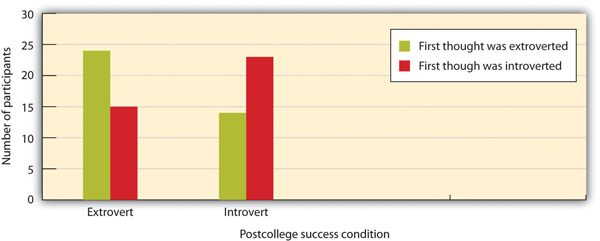
Sanitioso, Kunda, and Fong (1990) institute that students who had learned that extroverts did better than introverts after graduating from college tended to list extroverted memories almost themselves, whereas those who learned that introverts did improve than extroverts tended to list introverted memories.
It appears that the participants drew from their memories those instances of their own behavior that reflected the trait that had the well-nigh positive implications for their self-esteem—either introversion or extroversion, depending on experimental condition. The desire for positive self-esteem made events that were consistent with a positive cocky-perception more accessible, and thus they were listed first on the questionnaire.
Other research has confirmed this general principle—people often endeavor to create positive cocky-esteem whenever possible, fifty-fifty it if involves distorting reality. We tend to have credit for our successes, and to blame our failures on others. We remember more of our positive experiences and fewer of our negative ones. As we saw in the word of the optimistic bias in the previous chapter virtually social noesis, we approximate our likelihood of success and happiness equally greater than our likelihood of failure and unhappiness. Nosotros think that our sense of humor and our honesty are to a higher place boilerplate, and that we are better drivers and less prejudiced than others. We also distort (in a positive way, of form) our memories of our grades, our performances on exams, and our romantic experiences. And we believe that we tin control the events that we will feel to a greater extent than nosotros really tin (Crocker & Park, 2004).
Once more, though, there are some important cultural differences to note with people in individualistic cultures pursuing these self-enhancing strategies more vigorously and more oftentimes than those from more than collectivistic backgrounds. Indeed, in a big-scale review of studies on self-enhancement, Heine (2004) concluded that these tactics are not typically used in cultures that value interdependence over dependence. In cultures where high cocky-esteem is non as socially valued, people presumably do non feel the same need to misconstrue their social realities to serve their self-worth.
In that location is likewise considerable personal variety in the tendency to apply self-enhancement. Stable differences between individuals have been uncovered in many studies across a range of cocky-enhancing strategies (Hepper, Gramzow, & Sedikides, 2010; John & Robins, 1994; Kwan, John, Kenny, Bond, & Robins, 2004).
Narcissism and the Limits of Self-Enhancement
Our discussion to this signal suggests that many people will generally effort to view themselves in a positive light. We emphasize our positive characteristics, and nosotros may even in some cases distort information—all to help u.s.a. maintain positive cocky-esteem. There tin be negative aspects to having too much self-esteem, nevertheless, particularly if that esteem is unrealistic and undeserved. Narcissism is a personality trait characterized by overly high self-esteem, cocky-admiration, and self-centeredness. Narcissists tend to agree with statements such as the following:
- "I know that I am good because everybody keeps telling me so."
- "I can usually talk my fashion out of anything."
- "I like to be the center of attention."
- "I have a natural talent for influencing people."
Narcissists can be perceived as mannerly at first, merely often alienate others in the long run (Baumeister, Campbell, Krueger, & Vohs, 2003). They tin too make bad romantic partners as they often behave selfishly and are always ready to look for someone else who they think will be a meliorate mate, and they are more likely to exist unfaithful than not-narcissists (Campbell & Foster, 2002; Campbell, Rudich, & Sedikides, 2002). Narcissists are also more likely to bully others, and they may respond very negatively to criticism (Baumeister et al., 2003). People who have narcissistic tendencies more often pursue self-serving behaviors, to the detriment of the people and communities surrounding them (Campbell, Bush, Brunell, & Shelton, 2005). Perhaps surprisingly, narcissists seem to understand these things nigh themselves, although they appoint in the behaviors anyway (Carlson, Vazire, & Oltmanns, 2011).
Interestingly, scores on measures of narcissistic personality traits have been creeping steadily upward in contempo decades in some cultures (Twenge, Konrath, Foster, Campbell, & Bushman, 2008). Given the social costs of these traits, this is troubling news. What reasons might there be for these trends? Twenge and Campbell (2009) argue that several interlocking factors are at piece of work here, namely increasingly child-centered parenting styles, the cult of celebrity, the role of social media in promoting self-enhancement, and the wider availability of easy credit, which, they argue, has lead to more people being able to acquire status-related appurtenances, in turn further fueling a sense of entitlement. As narcissism is partly about having an excess of self-esteem, it should by at present come as no surprise that narcissistic traits are college, on average, in people from individualistic versus collectivistic cultures (Twenge et al., 2008).
The negative outcomes of narcissism raise the interesting possibility that high self-esteem in general may not ever be advantageous to us or to the people effectually u.s.a.. One complication to the outcome is that explicit self-report measures of cocky-esteem, similar the Rosenberg scale, are not able to distinguish between people whose loftier self-esteem is realistic and appropriate and those whose self-esteem may exist more inflated, even narcissistic (Baumeister et al., 2003). Implicit measures also do not provide a clear pic, just indications are that more narcissistic people score higher on implicit cocky-esteem in relation to some traits, including those relating to social status, and lower on others relating to relationships (Campbell, Bosson, Goheen, Lakey, & Kernis, 2007). A primal point is that information technology tin be difficult to uncrease what the effects of realistic versus unrealistic high self-esteem may be. Still, it is to this thorny event that we volition now turn.
Social Psychology in the Public Interest
Does High Self-Esteem Crusade Happiness or Other Positive Outcomes?
Teachers, parents, school counselors, and people in many cultures frequently assume that loftier cocky-esteem causes many positive outcomes for people who have information technology and therefore that we should try to increase it in ourselves and others. Perhaps yous agree with the idea that if you could increase your cocky-esteem, you would experience better about yourself and therefore be able to work at a higher level, or attract a more desirable mate. If you do believe that, you would not be alone. Baumeister and colleagues (2003) describe the origins and momentum of what they telephone call the cocky-esteem motility, which has grown in influence in various countries since the 1970s. For example, in 1986, the state of California funded a job force under the premise that raising self-esteem would help solve many of the state's problems, including law-breaking, teen pregnancy, drug abuse, school underachievement, and pollution.
Baumeister and colleagues (2003) conducted an extensive review of the research literature to determine whether having high self-esteem was equally helpful every bit many people seem to think information technology is. They began past assessing which variables were correlated with high self-esteem and so considered the extent to which loftier self-esteem caused these outcomes. They found that high self-esteem does correlate with many positive outcomes. People with high cocky-esteem become amend grades, are less depressed, experience less stress, and may fifty-fifty live longer than those who view themselves more than negatively. The researchers likewise constitute that high self-esteem is correlated with greater initiative and activity; people with high self-esteem just practise more things. They are also more than more likely to defend victims against bullies compared with people with low self-esteem, and they are more likely to initiate relationships and to speak up in groups. High cocky-esteem people besides piece of work harder in response to initial failure and are more willing to switch to a new line of endeavour if the present i seems unpromising. Thus, having loftier cocky-esteem seems to be a valuable resource—people with high self-esteem are happier, more than active, and in many ways better able to bargain with their environment.
On the other hand, Baumeister and his colleagues also found that people with high self-esteem sometimes delude themselves. They tend to believe that they are more likable and attractive, have improve relationships, and brand better impressions on others than people with depression self-esteem. But objective measures show that these beliefs are often distortions rather than facts. Furthermore, people with overly high cocky-esteem, particularly when information technology is accompanied by narcissism, defensiveness, conceit, and the unwillingness to critically assess one'southward potential negative qualities, have been found to engage in a variety of negative behaviors (Baumeister, Smart, & Boden, 1996). For case, people with high self-esteem are more probable to be bullies (despite as well being more likely to defend victims) and to experiment with alcohol, drugs, and sex.
Todd Heatherton and Kathleen Vohs (2000) establish that when people with extremely high cocky-esteem were forced to fail on a difficult job in front end of a partner, they responded by acting more unfriendly, rudely, and arrogantly than did those with lower self-esteem. And research has establish that children who inflate their social self-worth—those who call back that they are more popular than they really are and who thus have unrealistically high self-esteem—are also more ambitious than children who do not evidence such egotistic tendencies (Sandstrom & Herlan, 2007; Thomaes, Bushman, Stegge, & Olthof, 2008). Such findings raise the interesting possibility that programs that increase the self-esteem of children who bully and are aggressive, based on the notion that these behaviors stem from low self-esteem, may do more harm than good (Emler, 2001). If you are thinking like a social psychologist, these findings may not surprise you—narcissists tend to focus on their cocky-concerns, with little concern for others, and nosotros have seen many times that other-business concern is a necessity for satisfactory social relations.
Furthermore, despite the many positive variables that relate to loftier self-esteem, when Baumeister and his colleagues looked at the causal role of cocky-esteem they found little bear witness that high self-esteem caused these positive outcomes. For instance, although high self-esteem is correlated with academic accomplishment, information technology is more the result than the cause of this achievement. Programs designed to boost the cocky-esteem of pupils have not been shown to amend academic operation, and laboratory studies have generally failed to discover that manipulations of self-esteem cause better task performance.
Baumeister and his colleagues concluded that programs designed to heave self-esteem should be used only in a express way and should not be the only arroyo taken. Raising self-esteem will not make immature people exercise ameliorate in school, obey the law, stay out of trouble, get along amend with other people, or respect the rights of others. And these programs may even backlash if the increased self-esteem creates narcissism or conceit. Baumeister and his colleagues suggested that attempts to heave self-esteem should only be carried out every bit a reward for skilful behavior and worthy achievements, and not only to effort to make children feel better about themselves.
Although we naturally want to accept social status and loftier self-esteem, we cannot always promote ourselves without any regard to the accurateness of our self-characterizations. If we consistently distort our capabilities, and particularly if we do this over a long catamenia of time, we volition only end upward fooling ourselves and maybe engaging in behaviors that are not really beneficial to usa. Most of us probably know someone who is convinced that he or she has a particular talent at a professional level, but nosotros, and others, can encounter that this person is deluded (but perhaps nosotros are as well kind to say this). Some individuals who audience on television talent shows leap to mind. Such self-mirage can become problematic because although this high self-esteem might propel people to piece of work harder, and although they may enjoy thinking positively nearly themselves, they may be setting themselves up for long-term disappointment and failure. Their pursuit of unrealistic goals may also take valuable time away from finding areas they have more chance to succeed in.
When we self-enhance too much, although nosotros may feel adept most it in the short term, in the longer term the outcomes for the self may not exist positive. The goal of creating and maintaining positive self-esteem (an melancholia goal) must exist tempered by the cognitive goal of having an authentic self-view (Kirkpatrick & Ellis, 2001; Swann, Chang-Schneider, & Angulo, 2007). In some cases, the cognitive goal of obtaining an accurate picture of ourselves and our social earth and the melancholia goal of gaining positive self-esteem piece of work paw in hand. Getting the best grade in an important examination produces accurate knowledge about our skills in the domain too as giving us some positive self-esteem. In other cases, the two goals are incompatible. Doing more poorly on an examination than nosotros had hoped produces conflicting, contradictory outcomes. The poor score provides authentic information virtually the self—namely, that we have not mastered the subject—but at the aforementioned fourth dimension makes u.s.a. feel bad.Self-verification theory states that people frequently seek confirmation of their self-concept, whether it is positive or negative (Swann, 1983). This sets up a fascinating clash between our need to self-enhance against our need to be realistic in our views of ourselves. Delusion versus truth: which i wins out? The respond, of grade, every bit with pretty much everything to do with homo social behavior, is that it depends. But on what does it depend?
I gene is who the source is of the feedback about united states: when we are seeking out close relationships, we more than often class them with others who verify our self-views. Nosotros also tend to experience more satisfied with interactions with self-verifying partners than those who are always positive toward us (Swann, De La Ronde, & Hixon, 1994; Swann & Pelham, 2002). Self-verification seems to be less of import to us in more distant relationships, as in those cases we oftentimes tend to prefer cocky-enhancing feedback.
Another related factor is the part of our self-concept we are seeking feedback nearly, coupled with who is providing this evaluation. Let'south say yous are in a romantic human relationship and you ask your partner and your shut friend well-nigh how physically attractive they think you lot are. Who would you desire to requite you cocky-enhancing feedback? Who would you want more honesty from? The show suggests that almost of us would prefer self-enhancing feedback from our partner, and accurateness from our friend (Swann, Bosson, & Pelham, 2002), equally perceived physical bewitchery is more central to romance than friendship.
Under certain conditions, verification prevails over enhancement. Notwithstanding, we should not underestimate the power of cocky-enhancement to oftentimes cloud our ability to exist more realistic nigh ourselves. For case, self-verification of negative aspects of our self-concept is more than probable in situations where we are pretty sure of our faults (Swann & Pelham, 1988). If at that place is room for doubt, so enhancement tends to rule. Also, if we are confident that the consequences of getting innaccurate, self-enhancing feedback about negative aspects ourselves are minimal, so we tend to welcome cocky-enhancement with open arms (Aronson, 1992).
Therefore, in those situations where the needs to enhance and to verify are in disharmonize, nosotros must learn to reconcile our self-concept with our self-esteem. Nosotros must be able to take our negative aspects and to work to overcome them. The power to remainder the cognitive and the affective features of the self helps usa create realistic views of ourselves and to translate these into more efficient and constructive behaviors.
There is i last cautionary notation about focusing too much on self-enhancement, to the detriment of self-verification, and other-concern. Jennifer Crocker and Lora Park (2004) have identified another cost of our attempts to inflate our self-esteem: we may spend and then much time trying to enhance our self-esteem in the eyes of others—by focusing on the clothes we are wearing, impressing others, and so along—that we have niggling time left to really better ourselves in more meaningful ways. In some extreme cases, people experience such stiff needs to improve their self-esteem and social status that they act in assertive or ascendant means in order to gain it. As in many other domains, then, having positive self-esteem is a expert affair, but nosotros must exist careful to atmosphere it with a healthy realism and a concern for others. The existent irony here is that those people who do show more other- than cocky-business organization, those who appoint in more prosocial behavior at personal costs to themselves, for example, frequently tend to accept higher self-esteem anyway (Leak & Leak, 2003).
- Self-esteem refers to the positive (loftier cocky-esteem) or negative (depression cocky-esteem) feelings that nosotros accept about ourselves.
- Cocky-esteem is determined both by our ain achievements and accomplishments and by how we call back others are judging united states.
- Cocky-esteem can exist measured using both straight and indirect measures, and both approaches notice that people tend to view themselves positively.
- Cocky-esteem shows important variations across unlike cultural, gender, and age groups.
- Because it is so important to have self-esteem, we may seek out, process, and remember data in a way that allows us to come across ourselves fifty-fifty more positively.
- High self-esteem is correlated with, but does not cause, a diversity of positive outcomes.
- Although high self-esteem does correlate with many positive outcomes in life, overly high self-esteem creates narcissism, which can lead to unfriendly, rude, and ultimately dysfunctional behaviors.
- In what means do y'all attempt to boost your own cocky-esteem? Which strategies do you feel accept been particularly effective and ineffective and why?
- Do yous know people who have accordingly high self-esteem? What near people who are narcissists? How do these individual differences influence their social behavior in positive and negative ways?
- "It is relatively easy to succeed in life with depression self-esteem, but very difficult to succeed without cocky-control, self-field of study, or emotional resilience in the face of setbacks" (Twenge & Campbell, 2009, p. 295). To what extent do you agree with this quote and why?
References
Aronson, E. (1992). The render of the repressed: Racket theory makes a comeback. Psychological Inquiry, iii(4), 303–311.
Baumeister, R. F., Campbell, J. D., Krueger, J. I., & Vohs, Yard. D. (2003). Does high self-esteem cause meliorate performance, interpersonal success, happiness, or healthier lifestyles?Psychological Scientific discipline in the Public Involvement, 4(i), ane–44.
Baumeister, R. F., Smart, L., & Boden, J. M. (1996). Relation of threatened egotism to violence and aggression: The dark side of loftier self-esteem.Psychological Review, 103(1), 5–34.
Brown, J. D. (2010). Across the (not so) corking split: Cultural similarities in cocky-evaluative processes. Social and Personality Psychology Compass, 4, 318-330.
Cai, H., Brown, J. D., Deng, C., & Oakes, M. A. (2007). Self-esteem and culture: Differences in cognitive self-evaluations or affective self-regard?.Asian Periodical Of Social Psychology,10(three), 162-170. doi:10.1111/j.1467-839X.2007.00222.10
Campbell, J. D., Trapnell, P. D., Heine, South. J., Katz, I. M., Lavallee, L. F., & Lehman, D. R. (1996). Cocky-concept clarity: Measurement, personality correlates, and cultural boundaries. Journal of Personality and Social Psychology, 70(one), 141-156.
Campbell, W., Bosson, J. K., Goheen, T. W., Lakey, C. E., & Kernis, Thousand. H. (2007). Do narcissists dislike themselves 'deep downwards inside?'.Psychological Science,18(3), 227-229. doi:x.1111/j.1467-9280.2007.01880.10
Campbell, W., Bush, C., Brunell, A. B., & Shelton, J. (2005). Understanding the Social Costs of Narcissism: The Instance of the Tragedy of the Eatables.Personality And Social Psychology Bulletin,31(10), 1358-1368. doi:10.1177/0146167205274855
Campbell, Westward. K., & Foster, C. A. (2002). Narcissism and commitment in romantic relationships: An investment model analysis.Personality and Social Psychology Message, 28, 484–495.
Campbell, W. K., Rudich, East., & Sedikides, C. (2002). Narcissism, self-esteem, and the positivity of self-views: Two portraits of self-love.Personality and Social Psychology Message, 28, 358–368.
Carlson, E. Due north., Vazire, South., & Oltmanns, T. F. (2011). You probably think this newspaper's about you: Narcissists' perceptions of their personality and reputation.Journal of Personality and Social Psychology, 101(1), 185–201.
Crocker, J., & Park, L. E. (2004). The plush pursuit of self-esteem.Psychological Message, 130, 392–414.
Emler, N. (2001). Self esteem: The costs and causes of low cocky worth. York: York Publishing Services.
Greenwald, A. G., & Farnham, S. D. (2000). Using the Implicit Clan Exam to measure self-esteem and self-concept.Journal of Personality and Social Psychology, 79(half-dozen), 1022–1038.
Heatherton, T. F., & Vohs, K. D. (2000). Interpersonal evaluations following threats to self: Role of cocky-esteem.Journal of Personality and Social Psychology, 78, 725–736.
Heine, S. J. (2004). Positive self-views: Agreement universals and variability.Journal of Cultural and Evolutionary Psychology,two, 109-122.
Heine, S. J., & Lehman, D. R. (1999). Civilization, cocky-discrepancies, and self-satisfaction.Personality And Social Psychology Bulletin,25(8), 915-925. doi:x.1177/01461672992511001
Heine, Due south. J., Lehman, D. R., Markus, H. R., & Kitayama, Southward. (1999). Is in that location a universal need for positive self-regard? Psychological Review, 106(4), 766-794. doi: 10.1037/0033-295X.106.four.766
Held, B. Southward., (2002) The tyranny of the positive mental attitude in America: Observation and speculation. Journal of Clinical Psychology, 58, 965-992. doi: 10.1002/jclp.10093
Helgeson, V. S., & Mickelson, 1000. (2000). Coping with chronic disease amid the elderly: Maintaining self-esteem. In South. B. Manuck, R. Jennings, B. S. Rabin, & A. Baum (Eds.),Beliefs, health, and crumbling.Mahwah, NJ: Erlbaum.
Hepper, E. Grand., Gramzow, R. H., & Sedikides, C. (2010). Individual differences in self-enhancement and cocky-protection strategies: An integrative assay.Journal Of Personality,78(two), 781-814. doi:10.1111/j.1467-6494.2010.00633.ten
John, O. P., & Robins, R. Westward. (1994). Accuracy and bias in self-perception: Individual differences in cocky-enhancement and the function of narcissism.Journal Of Personality And Social Psychology,66(1), 206-219. doi:10.1037/0022-3514.66.ane.206
Kirkpatick, L. A., & Ellis, B. J. (2001). Evolutionary perspectives on cocky-evaluation and cocky-esteem. In M. Clark & G. Fletcher (Eds.),The Blackwell Handbook of Social Psychology, Vol. 2: Interpersonal processes (pp. 411–436). Oxford, UK: Blackwell.
Kling, K. C., Hyde, J., Showers, C. J., & Buswell, B. N. (1999). Gender differences in self-esteem: A meta-analysis.Psychological Bulletin,125(4), 470-500. doi:10.1037/0033-2909.125.4.470
Kwan, V. Y., John, O. P., Kenny, D. A., Bail, M. H., & Robins, R. W. (2004). Reconceptualizing individual differences in self-enhancement bias: An interpersonal approach.Psychological Review,111(ane), 94-110. doi:ten.1037/0033-295X.111.1.94
Leak, G. M., & Leak, K. C. (2003). Adlerian Social Interest and Positive Psychology: A Conceptual and Empirical Integration.The Journal of Private Psychology, 62(3), 207-223.
Mead, G. H. (1934).Heed, Self, and Society. Chicago: University of Chicago Printing.
Robins, R. West., Trzesniewski, K. H., Tracy, J. L., Gosling, Southward. D., & Potter, J. (2002). Global self-esteem across the life bridge.Psychology and Crumbling, 17,423-434.
Rosenberg, Yard. (1965). Society and the adolescent cocky-image. Princeton, NJ: Princeton University Press.
Rothermund, M., & Brandtstadter, J. (2003). Coping with deficits and loss in later life: From compensatory action to accommodation.Psychology and Aging, 18,896-905.
Ryff, C. D. (1991). Possible selves in adulthood and sometime historic period: A tale of shifting horizons.Psychology and Crumbling, half dozen,286-295.
Sandstrom, M. J., & Herlan, R. D. (2007). Threatened egotism or confirmed inadequacy? How children'south perceptions of social status influence ambitious beliefs toward peers.Journal of Social and Clinical Psychology, 26(2), 240–267.
Sanitioso, R., Kunda, Z., & Fong, M. T. (1990). Motivated recruitment of autobiographical memories.Periodical of Personality and Social Psychology, 59(ii), 229–241.
Schlenker, B. R. (2003). Self-presentation. In G. R. Leary, J. P. Tangney, K. R. E. Leary, & J. P. East. Tangney (Eds.),Handbook of cocky and identity (pp. 492–518). New York, NY: Guilford Press.
Sprecher, S., Brooks, J. Due east., & Avogo, W. (2013). Self-esteem among immature adults: Differences and similarities based on gender, race, and cohort (1990–2012).Sex activity Roles,69(5-6), 264-275.
Swann, West. B., Jr. (1983). Self-verification: Bringing social reality into harmony with the self. In J. Suls & A. Grand. Greenwald (Eds.), Psychological perspectives on the self (Vol. 2, pp. 33–66), Hillsdale, NJ: Erlba
Swann, W. B., Bosson, J. 1000., & Pelham, B. W. (2002). Different partners, different selves: Strategic verification of circumscribed identities.Personality And Social Psychology Bulletin,28(ix), 1215-1228. doi:10.1177/01461672022812007
Swann, West. B., Jr., Chang-Schneider, C., & Angulo, S. (2007). Cocky-verification in relationships as an adaptive process. In J. Wood, A. Tesser, & J. Holmes (Eds.),Self and relationships. New York, NY: Psychology Press.
Swann, W. B., Jr., De La Ronde, C., & Hixon, J. G. (1994). Authenticity and positivity strivings in wedlock and courtship.Periodical of Personality and Social Psychology, 66, 857–869.
Swann, W. B., Jr., & Pelham, B. W. (2002). Who wants out when the going gets good? Psychological investment and preference for self-verifying higher roommates.Journal of Self and Identity, one, 219–233.
Tafarodi, R. W., & Swann, W. B., Jr. (1995). Cocky-liking and cocky-competence as dimensions of global cocky-esteem: Initial validation of a measure out.Journal of Personality Assessment, 65(2), 322–342.
Thomaes, South., Bushman, B. J., Stegge, H., & Olthof, T. (2008). Trumping shame by blasts of dissonance: Narcissism, self-esteem, shame, and aggression in young adolescents.Child Development, 79(6), 1792–1801.
Tobin, Vanman, Verreynne, & Saeri, A. K. (2014). Threats to belonging on Facebook: Lurking and ostracism. Social Influence. doi:10.1080/15534510.2014.893924
Twenge J. (2011). Narcissism and culture.The handbook of narcissism and narcissistic personality disorder: Theoretical approaches, empirical findings, and treatments [east-book]. Hoboken, NJ US: John Wiley & Sons Inc.
Twenge, J., & Campbell, W. One thousand. (2009).The narcissism epidemic.New York, NY: Free Press.
Twenge, J. M., Konrath, S., Foster, J. D., Campbell, W., & Bushman, B. J. (2008). Egos inflating over time: A cantankerous-temporal meta-analysis of the Egotistic Personality Inventory.Journal Of Personality,76(4), 875-902. doi:10.1111/j.1467-6494.2008.00507.ten
Yamaguchi, South., Greenwald, A. One thousand., Banaji, Yard. R., Murakami, F., Chen, D., Shiomura, K., & … Krendl, A. (2007). Credible universality of positive implicit cocky-esteem.Psychological Science,18(vi), 498-500. doi:x.1111/j.1467-9280.2007.01928.ten
Source: https://opentextbc.ca/socialpsychology/chapter/the-feeling-self-self-esteem/
0 Response to "Being Rejected by a Peer Group Can Negatively Influence One's Self-esteem."
Postar um comentário