what phase must be moon be for earth to have a chance to see a solar eclipse?
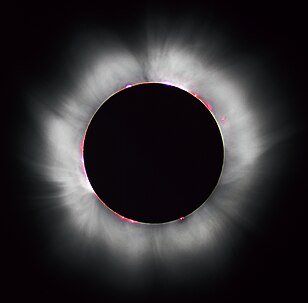 A total solar eclipse occurs when the Moon completely covers the Sun's disk, every bit seen in this 1999 solar eclipse. Solar prominences can exist seen along the limb (in red) equally well as all-encompassing coronal filaments. | |
 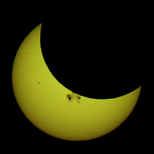 An annular solar eclipse (left) occurs when the Moon is also far away to completely cover the Lord's day's disk (May 20, 2012). During a partial solar eclipse (right), the Moon blocks only part of the Sun's disk (October 23, 2014). |
A solar eclipse occurs when a portion of the World is engulfed in a shadow cast past the Moon which fully or partially blocks sunlight. This occurs when the Sun, Moon and Earth are aligned. Such alignment coincides with a new moon (syzygy) indicating the Moon is closest to the ecliptic plane.[i] In a total eclipse, the disk of the Sun is fully obscured by the Moon. In fractional and annular eclipses, simply part of the Sun is obscured.
If the Moon were in a perfectly circular orbit, a little closer to the Earth, and in the same orbital plane, in that location would be total solar eclipses every new moon. However, since the Moon's orbit is tilted at more 5 degrees to the Earth'southward orbit around the Sun, its shadow usually misses Globe. A solar eclipse can occur merely when the Moon is close plenty to the ecliptic plane during a new moon. Special atmospheric condition must occur for the two events to coincide because the Moon'due south orbit crosses the ecliptic at its orbital nodes twice every draconic month (27.212220 days) while a new moon occurs one every synodic month (29.53059 days). Solar (and lunar) eclipses therefore happen only during eclipse seasons resulting in at least two, and up to five, solar eclipses each yr; no more 2 of which tin can be total eclipses.[ii] [iii]
Full eclipses are rare because the timing of the new moon inside the eclipse season needs to be more verbal for an alignment between the observer (on Earth) and the centers of the Sun and Moon. In addition, the elliptical orbit of the Moon frequently takes it far enough away from Earth that its apparent size is non large plenty to block the Lord's day entirely. Total solar eclipses are rare at any particular location because totality exists but along a narrow path on the World's surface traced past the Moon's total shadow or umbra.
An eclipse is a natural phenomenon. However, in some ancient and mod cultures, solar eclipses were attributed to supernatural causes or regarded as bad omens. A total solar eclipse tin can be frightening to people who are unaware of its astronomical explanation, every bit the Dominicus seems to disappear during the twenty-four hours and the sky darkens in a matter of minutes.
Since looking directly at the Sun tin can lead to permanent middle damage or blindness, special eye protection or indirect viewing techniques are used when viewing a solar eclipse. It is safe to view only the total phase of a total solar eclipse with the unaided eye and without protection. This practice must be undertaken advisedly, though the farthermost fading of the solar brightness by a factor of over 100 times in the concluding minute before totality makes information technology obvious when totality has begun and it is for that farthermost variation and the view of the solar corona that leads people to travel to the zone of totality (the partial phases bridge over 2 hours while the total phase can last but a maximum of vii.five minutes for whatsoever one location and is usually less). People referred to every bit eclipse chasers or umbraphiles will travel even to remote locations to observe or witness predicted fundamental solar eclipses.[4] [5]
Types

Partial and annular phases of solar eclipse on May xx, 2012
There are four types of solar eclipses:
- A total eclipse occurs when the dark silhouette of the Moon completely obscures the intensely vivid calorie-free of the Sun, assuasive the much fainter solar corona to be visible. During any 1 eclipse, totality occurs at all-time but in a narrow track on the surface of World.[6] This narrow runway is called the path of totality.[7]
- An annular eclipse occurs when the Lord's day and Moon are exactly in line with the Globe, but the apparent size of the Moon is smaller than that of the Lord's day. Hence the Sun appears equally a very bright ring, or annulus, surrounding the dark disk of the Moon.[8]
- A hybrid eclipse (also called annular/full eclipse) shifts between a total and annular eclipse. At certain points on the surface of Earth, it appears as a full eclipse, whereas at other points it appears as annular. Hybrid eclipses are comparatively rare.[eight]
- A partial eclipse occurs when the Dominicus and Moon are not exactly in line with the Earth and the Moon simply partially obscures the Sun. This phenomenon tin usually be seen from a large office of the World outside of the track of an annular or total eclipse. Even so, some eclipses tin can be seen just as a partial eclipse, because the umbra passes above the Earth's polar regions and never intersects the Earth's surface.[8] Partial eclipses are virtually unnoticeable in terms of the Sunday'due south brightness, equally it takes well over 90% coverage to notice any darkening at all. Even at 99%, it would be no darker than civil twilight.[9] Of grade, partial eclipses (and partial stages of other eclipses) can be observed if 1 is viewing the Sun through a concealment filter (which should always exist used for condom).

Comparison of minimum and maximum apparent sizes of the Sun and Moon (and planets). An annular eclipse tin can occur when the Sun has a larger credible size than the Moon, whereas a total eclipse can occur when the Moon has a larger apparent size.
The Sun's distance from Earth is about 400 times the Moon's distance, and the Sunday's diameter is most 400 times the Moon'due south diameter. Because these ratios are approximately the same, the Sun and the Moon every bit seen from Earth appear to be approximately the same size: almost 0.5 degree of arc in angular measure.[8]
A separate category of solar eclipses is that of the Sun being occluded by a body other than the Earth'south Moon, as can be observed at points in space away from the Globe's surface. 2 examples are when the crew of Apollo 12 observed the Earth eclipse the Dominicus in 1969 and when the Cassini probe observed Saturn eclipsing the Dominicus in 2006.
The Moon's orbit effectually the Earth is slightly elliptical, every bit is the Earth's orbit around the Sun. The credible sizes of the Sun and Moon therefore vary.[10] The magnitude of an eclipse is the ratio of the apparent size of the Moon to the credible size of the Sun during an eclipse. An eclipse that occurs when the Moon is near its closest distance to Earth (i.e., near its perigee) can be a total eclipse because the Moon volition appear to be large plenty to completely cover the Sun's bright deejay or photosphere; a total eclipse has a magnitude greater than or equal to i.000. Conversely, an eclipse that occurs when the Moon is near its farthest distance from Earth (i.e., near its apogee) tin can exist only an annular eclipse because the Moon volition appear to be slightly smaller than the Lord's day; the magnitude of an annular eclipse is less than 1.[11]
A hybrid eclipse occurs when the magnitude of an eclipse changes during the event from less to greater than i, so the eclipse appears to be total at locations nearer the midpoint, and annular at other locations nearer the first and end, since the sides of the Globe are slightly further away from the Moon. These eclipses are extremely narrow in their path width and relatively brusk in their elapsing at any point compared with fully full eclipses; the 2023 April 20 hybrid eclipse'southward totality is over a infinitesimal in duration at various points forth the path of totality. Like a focal point, the width and duration of totality and annularity are nigh nil at the points where the changes between the two occur.[12]
Because the Earth's orbit around the Dominicus is also elliptical, the Globe's distance from the Sunday similarly varies throughout the year. This affects the apparent size of the Sun in the same way, but non every bit much every bit does the Moon'due south varying altitude from Globe.[viii] When Earth approaches its farthest distance from the Sun in early July, a total eclipse is somewhat more likely, whereas conditions favour an annular eclipse when Earth approaches its closest distance to the Sun in early January.[xiii]
Terminology for key eclipse

Each icon shows the view from the centre of its blackness spot, representing the Moon (not to scale)

Diamond band issue at third contact—the end of totality—with visible prominences
Central eclipse is frequently used as a generic term for a total, annular, or hybrid eclipse.[xiv] This is, however, not completely correct: the definition of a primal eclipse is an eclipse during which the central line of the umbra touches the Earth'southward surface. It is possible, though extremely rare, that part of the umbra intersects with the Globe (thus creating an annular or total eclipse), but not its central line. This is then called a not-key full or annular eclipse.[fourteen] Gamma is a measure of how centrally the shadow strikes. The last (umbral all the same) not-central solar eclipse was on April 29, 2014. This was an annular eclipse. The side by side non-central total solar eclipse will exist on April nine, 2043.[15]
The visual phases observed during a total eclipse are called:[sixteen]
- Outset contact—when the Moon's limb (edge) is exactly tangential to the Sun's limb.
- 2nd contact—starting with Baily's Beads (caused by light shining through valleys on the Moon'south surface) and the diamond band effect. Most the entire disk is covered.
- Totality—the Moon obscures the entire disk of the Sun and only the solar corona is visible.
- Third contact—when the first brilliant light becomes visible and the Moon's shadow is moving away from the observer. Once again a diamond ring may be observed.
- Fourth contact—when the trailing border of the Moon ceases to overlap with the solar disk and the eclipse ends.
Predictions
Geometry
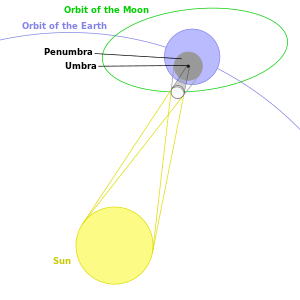
Geometry of a total solar eclipse (not to calibration)
The diagrams to the right testify the alignment of the Lord's day, Moon, and Globe during a solar eclipse. The nighttime gray region between the Moon and Earth is the umbra, where the Sun is completely obscured by the Moon. The small area where the umbra touches World's surface is where a total eclipse can be seen. The larger lite gray area is the penumbra, in which a partial eclipse tin exist seen. An observer in the antumbra, the area of shadow across the umbra, volition see an annular eclipse.[17]
The Moon'south orbit effectually the Globe is inclined at an angle of just over 5 degrees to the plane of the World's orbit effectually the Sun (the ecliptic). Because of this, at the time of a new moon, the Moon will usually pass to the northward or s of the Sun. A solar eclipse can occur only when a new moon occurs close to one of the points (known equally nodes) where the Moon'southward orbit crosses the ecliptic.[18]
Equally noted above, the Moon'due south orbit is also elliptical. The Moon'south distance from the World can vary by nearly vi% from its average value. Therefore, the Moon's apparent size varies with its distance from the Earth, and it is this effect that leads to the deviation between total and annular eclipses. The altitude of the Earth from the Sun also varies during the yr, but this is a smaller effect. On average, the Moon appears to be slightly smaller than the Sun as seen from the Earth, so the bulk (nearly 60%) of primal eclipses are annular. It is but when the Moon is closer to the World than average (near its perigee) that a full eclipse occurs.[nineteen] [twenty]
| Moon | Dominicus | |||
|---|---|---|---|---|
| At perigee (nearest) | At apogee (farthest) | At perihelion (nearest) | At aphelion (farthest) | |
| Mean radius | 1,737.x km (i,079.38 mi) | 696,000 km (432,000 mi) | ||
| Altitude | 363,104 km (225,622 mi) | 405,696 km (252,088 mi) | 147,098,070 km (91,402,500 mi) | 152,097,700 km (94,509,100 mi) |
| Angular bore[21] | 33' 30" (0.5583°) | 29' 26" (0.4905°) | 32' 42" (0.5450°) | 31' 36" (0.5267°) |
| Credible size to scale |  |  |  |  |
| Society by decreasing apparent size | 1st | 4th | 2d | tertiary |
The Moon orbits the Earth in approximately 27.3 days, relative to a fixed frame of reference. This is known as the sidereal month. However, during one sidereal month, Earth has revolved part way around the Sun, making the boilerplate fourth dimension betwixt one new moon and the next longer than the sidereal month: it is approximately 29.5 days. This is known equally the synodic calendar month and corresponds to what is commonly called the lunar month.[18]
The Moon crosses from s to due north of the ecliptic at its ascending node, and vice versa at its descending node.[18] However, the nodes of the Moon's orbit are gradually moving in a retrograde motion, due to the action of the Sunday's gravity on the Moon's motion, and they make a complete excursion every 18.half dozen years. This regression ways that the time betwixt each passage of the Moon through the ascending node is slightly shorter than the sidereal calendar month. This period is called the nodical or draconic month.[22]
Finally, the Moon's perigee is moving frontward or precessing in its orbit and makes a complete circuit in 8.85 years. The fourth dimension betwixt one perigee and the side by side is slightly longer than the sidereal month and known equally the anomalistic month.[23]
The Moon'due south orbit intersects with the ecliptic at the ii nodes that are 180 degrees apart. Therefore, the new moon occurs close to the nodes at two periods of the year approximately vi months (173.iii days) apart, known as eclipse seasons, and in that location will always be at least 1 solar eclipse during these periods. Sometimes the new moon occurs close enough to a node during two consecutive months to eclipse the Sun on both occasions in 2 partial eclipses. This means that, in whatsoever given year, there volition e'er be at least two solar eclipses, and there can be as many as 5.[24]
Eclipses can occur merely when the Sun is within nearly fifteen to eighteen degrees of a node, (10 to 12 degrees for primal eclipses). This is referred to as an eclipse limit, and is given in ranges considering the apparent sizes and speeds of the Dominicus and Moon vary throughout the year. In the fourth dimension it takes for the Moon to return to a node (draconic calendar month), the apparent position of the Dominicus has moved about 29 degrees, relative to the nodes.[2] Since the eclipse limit creates a window of opportunity of upward to 36 degrees (24 degrees for fundamental eclipses), it is possible for partial eclipses (or rarely a partial and a central eclipse) to occur in consecutive months.[25] [26]

Fraction of the Lord's day's disc covered, f, when the aforementioned-sized discs are offset a fraction t of their diameter.[27]
Path
During a key eclipse, the Moon'southward umbra (or antumbra, in the example of an annular eclipse) moves rapidly from westward to eastward across the Earth. The Earth is also rotating from west to e, at about 28 km/min at the Equator, but as the Moon is moving in the same direction as the Earth's rotation at about 61 km/min, the umbra nigh ever appears to movement in a roughly west–east direction beyond a map of the Earth at the speed of the Moon's orbital velocity minus the Earth's rotational velocity.[28] Rare exceptions tin occur in polar regions where the path may go over or virtually the pole, as in 2021 on June 10 and December 4.
The width of the track of a central eclipse varies according to the relative apparent diameters of the Lord's day and Moon. In the most favourable circumstances, when a total eclipse occurs very shut to perigee, the runway can be up to 267 km (166 mi) wide and the duration of totality may be over 7 minutes.[29] Outside of the central runway, a partial eclipse is seen over a much larger area of the Earth. Typically, the umbra is 100–160 km wide, while the penumbral diameter is in excess of 6400 km.[30]
Besselian elements are used to predict whether an eclipse volition be fractional, annular, or total (or annular/total), and what the eclipse circumstances will be at any given location.[31] : Chapter 11 Calculations with Besselian elements can determine the exact shape of the umbra'south shadow on the Globe'southward surface. But at what longitudes on the World's surface the shadow volition fall, is a role of the Earth's rotation, and on how much that rotation has slowed downwards over time. A number chosen ΔT is used in eclipse prediction to take this slowing into business relationship. Every bit the Earth slows, ΔT increases. ΔT for dates in the time to come can only be roughly estimated because the Earth's rotation is slowing irregularly. This means that, although it is possible to predict that there will be a total eclipse on a certain engagement in the far time to come, it is not possible to predict in the far hereafter exactly at what longitudes that eclipse will be total. Historical records of eclipses allow estimates of past values of ΔT and and so of the Globe'southward rotation.
Elapsing
The following factors make up one's mind the duration of a full solar eclipse (in lodge of decreasing importance):[32] [33]
- The Moon beingness almost exactly at perigee (making its angular diameter equally large as possible).
- The World beingness very near aphelion (furthest away from the Sun in its elliptical orbit, making its athwart diameter near as small as possible).
- The midpoint of the eclipse being very close to the Globe'south equator, where the rotational velocity is greatest.
- The vector of the eclipse path at the midpoint of the eclipse aligning with the vector of the Globe'south rotation (i.east. not diagonal simply due e).
- The midpoint of the eclipse being well-nigh the subsolar bespeak (the part of the Earth closest to the Sun).
The longest eclipse that has been calculated thus far is the eclipse of July sixteen, 2186 (with a maximum elapsing of 7 minutes 29 seconds over northern Guyana).[32]
Occurrence and cycles

Total solar eclipse paths: 1001–2000, showing that total solar eclipses occur near everywhere on Earth. This image was merged from 50 divide images from NASA.[34]
Full solar eclipses are rare events. Although they occur somewhere on Earth every eighteen months on boilerplate,[35] it is estimated that they recur at any given place only once every 360 to 410 years, on average.[36] The total eclipse lasts for just a maximum of a few minutes at any location, because the Moon'southward umbra moves east at over 1700 km/h.[37] Totality currently can never final more than 7 min 32 south. This value changes over the millennia and is currently decreasing. By the 8th millennium, the longest theoretically possible full eclipse volition exist less than 7 min 2 s.[32] The final time an eclipse longer than 7 minutes occurred was June 30, 1973 (vii min three sec). Observers aboard a Concorde supersonic aircraft were able to stretch totality for this eclipse to well-nigh 74 minutes by flying along the path of the Moon'southward umbra.[38] The next full eclipse exceeding seven minutes in duration will not occur until June 25, 2150. The longest total solar eclipse during the xi,000 year period from 3000 BC to at least 8000 Advert volition occur on July 16, 2186, when totality will last 7 min 29 s.[32] [39] For comparison, the longest total eclipse of the 20th century at seven min eight s occurred on June 20, 1955, and there are no total solar eclipses over seven min in duration in the 21st century.[40]
It is possible to predict other eclipses using eclipse cycles. The saros is probably the best known and ane of the well-nigh accurate. A saros lasts half-dozen,585.three days (a little over 18 years), which means that, after this catamenia, a practically identical eclipse will occur. The most notable difference volition exist a due west shift of about 120° in longitude (due to the 0.3 days) and a little in latitude (northward-due south for odd-numbered cycles, the contrary for even-numbered ones). A saros series ever starts with a partial eclipse near 1 of Earth's polar regions, then shifts over the globe through a serial of annular or total eclipses, and ends with a partial eclipse at the contrary polar region. A saros series lasts 1226 to 1550 years and 69 to 87 eclipses, with about 40 to 60 of them beingness central.[41]
Frequency per year
Between ii and five solar eclipses occur every year, with at to the lowest degree i per eclipse flavor. Since the Gregorian calendar was instituted in 1582, years that have had five solar eclipses were 1693, 1758, 1805, 1823, 1870, and 1935. The next occurrence will be 2206.[42] On average, there are virtually 240 solar eclipses each century.[43]
| January 5 | Feb 3 | June 30 | July 30 | December 25 |
|---|---|---|---|---|
| Partial (due south) | Fractional (north) | Partial (north) | Partial (south) | Annular (south) |
 Saros 111 | 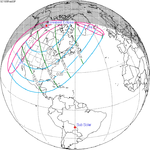 Saros 149 | 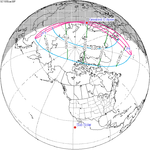 Saros 116 | 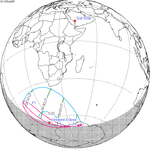 Saros 154 |  Saros 121 |
Concluding totality
Full solar eclipses are seen on Earth because of a fortuitous combination of circumstances. Fifty-fifty on Earth, the multifariousness of eclipses familiar to people today is a temporary (on a geological fourth dimension scale) miracle. Hundreds of millions of years in the past, the Moon was closer to the Globe and therefore apparently larger, then every solar eclipse was full or partial, and at that place were no annular eclipses. Due to tidal dispatch, the orbit of the Moon effectually the Earth becomes approximately 3.viii cm more afar each year. Millions of years in the future, the Moon will be too far abroad to fully occlude the Sun, and no total eclipses volition occur. In the same timeframe, the Sun may go brighter, making it appear larger in size.[44] Estimates of the time when the Moon volition be unable to occlude the unabridged Sun when viewed from the World range betwixt 650 million[45] and 1.4 billion years in the future.[44]
Historical eclipses

Historical eclipses are a very valuable resource for historians, in that they allow a few historical events to be dated precisely, from which other dates and ancient calendars may be deduced.[46] A solar eclipse of June 15, 763 BC mentioned in an Assyrian text is of import for the chronology of the ancient Nigh East.[47] There have been other claims to date before eclipses. The Book of Joshua 10:thirteen describes the sun staying still for an entire twenty-four hours in the sky; a group of Academy of Cambridge scholars concluded this to be the annular solar eclipse that occurred on thirty October 1207 BC.[48] The Chinese king Zhong Kang supposedly beheaded 2 astronomers, Hsi and Ho, who failed to predict an eclipse 4,000 years ago.[49] Perhaps the primeval however-unproven claim is that of archaeologist Bruce Masse, who putatively links an eclipse that occurred on May x, 2807, BC with a possible shooting star impact in the Indian Ocean on the basis of several ancient alluvion myths that mention a total solar eclipse.[50]

Records of the solar eclipses of 993 and 1004 as well as the lunar eclipses of 1001 and 1002 past Ibn Yunus of Cairo (c. 1005).
Eclipses have been interpreted every bit omens, or portents.[51] The ancient Greek historian Herodotus wrote that Thales of Miletus predicted an eclipse that occurred during a battle between the Medes and the Lydians. Both sides put downward their weapons and declared peace as a result of the eclipse.[52] The exact eclipse involved remains uncertain, although the issue has been studied by hundreds of ancient and modernistic authorities. 1 likely candidate took place on May 28, 585 BC, probably virtually the Halys river in Asia Minor.[53] An eclipse recorded past Herodotus earlier Xerxes departed for his expedition confronting Greece,[54] which is traditionally dated to 480 BC, was matched by John Russell Hind to an annular eclipse of the Lord's day at Sardis on February 17, 478 BC.[55] Alternatively, a partial eclipse was visible from Persia on October 2, 480 BC.[56] Herodotus also reports a solar eclipse at Sparta during the Second Persian invasion of Greece.[57] The date of the eclipse (August 1, 477 BC) does not match exactly the conventional dates for the invasion accepted by historians.[58]
Chinese records of eclipses brainstorm at around 720 BC.[59] The fourth century BC astronomer Shi Shen described the prediction of eclipses by using the relative positions of the Moon and Sun.[60]
Attempts have been fabricated to constitute the exact date of Expert Friday by assuming that the darkness described at Jesus'southward crucifixion was a solar eclipse. This inquiry has not yielded conclusive results,[61] [62] and Good Fri is recorded as beingness at Passover, which is held at the time of a total moon. Farther, the darkness lasted from the sixth hour to the ninth, or iii hours, which is much, much longer than the eight-infinitesimal upper limit for any solar eclipse's totality. Contemporary chronicles wrote nearly an eclipse at the beginning of May 664 that coincided with the beginning of the plague of 664 in the British isles.[63] In the Western hemisphere, at that place are few reliable records of eclipses before AD 800, until the appearance of Arab and monastic observations in the early medieval menses.[59] The Cairo astronomer Ibn Yunus wrote that the calculation of eclipses was ane of the many things that connect astronomy with the Islamic police force, considering it allowed knowing when a special prayer can be fabricated.[64] The commencement recorded observation of the corona was fabricated in Constantinople in AD 968.[56] [59]
The first known scope observation of a full solar eclipse was made in French republic in 1706.[59] Nine years later, English language astronomer Edmund Halley accurately predicted and observed the solar eclipse of May 3, 1715.[56] [59] By the mid-19th century, scientific understanding of the Sunday was improving through observations of the Dominicus'south corona during solar eclipses. The corona was identified equally part of the Dominicus'south atmosphere in 1842, and the first photograph (or daguerreotype) of a total eclipse was taken of the solar eclipse of July 28, 1851.[56] Spectroscope observations were made of the solar eclipse of August eighteen, 1868, which helped to determine the chemical composition of the Lord's day.[56]

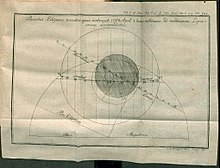
Illustration from De magna eclipsi solari, quae continget anno 1764 published in Acta Eruditorum, 1762
John Fiske summed up myths about the solar eclipse like this in his 1872 volume Myth and Myth-Makers,
the myth of Hercules and Cacus, the fundamental idea is the victory of the solar god over the robber who steals the lite. Now whether the robber carries off the light in the evening when Indra has gone to sleep, or boldly rears his black course confronting the sky during the daytime, causing darkness to spread over the earth, would make lilliputian difference to the framers of the myth. To a chicken a solar eclipse is the same thing every bit nightfall, and he goes to roost appropriately. Why, then, should the primitive thinker have made a distinction between the darkening of the heaven caused by black clouds and that caused by the rotation of the earth? He had no more conception of the scientific caption of these phenomena than the chicken has of the scientific explanation of an eclipse. For him it was enough to know that the solar radiance was stolen, in the one case as in the other, and to suspect that the aforementioned demon was to blame for both robberies.[65]
Viewing
Looking straight at the photosphere of the Sun (the bright disk of the Sun itself), fifty-fifty for just a few seconds, tin cause permanent damage to the retina of the center, because of the intense visible and invisible radiation that the photosphere emits. This damage can result in impairment of vision, upward to and including blindness. The retina has no sensitivity to hurting, and the effects of retinal damage may not announced for hours, and then there is no warning that injury is occurring.[66] [67]
Under normal conditions, the Sun is and then bright that information technology is difficult to stare at information technology directly. However, during an eclipse, with so much of the Sun covered, it is easier and more tempting to stare at it. Looking at the Lord's day during an eclipse is every bit dangerous equally looking at it outside an eclipse, except during the brief menses of totality, when the Sun's deejay is completely covered (totality occurs only during a total eclipse and just very briefly; information technology does not occur during a partial or annular eclipse). Viewing the Sunday's disk through any kind of optical aid (binoculars, a telescope, or fifty-fifty an optical camera viewfinder) is extremely hazardous and can crusade irreversible eye damage inside a fraction of a 2d.[68] [69]
Partial and annular eclipses

Eclipse glasses filter out middle damaging radiation, allowing direct viewing of the Sun during all partial eclipse phases; they are not used during totality, when the Sun is completely eclipsed

Pinhole projection method of observing partial solar eclipse. Insert (upper left): partially eclipsed Sun photographed with a white solar filter. Principal image: projections of the partially eclipsed Sun (bottom correct)
Viewing the Sun during partial and annular eclipses (and during full eclipses outside the brief menstruum of totality) requires special center protection, or indirect viewing methods if eye impairment is to be avoided. The Sun'due south disk can be viewed using advisable filtration to block the harmful part of the Dominicus's radiations. Sunglasses practice not make viewing the Lord's day condom. Only properly designed and certified solar filters should be used for directly viewing of the Sun's disk.[70] Particularly, self-made filters using common objects such every bit a floppy disk removed from its case, a Compact Disc, a black colour slide film, smoked glass, etc. must exist avoided.[71] [72]
The safest mode to view the Dominicus's deejay is past indirect projection.[73] This can exist done by projecting an prototype of the disk onto a white piece of paper or card using a pair of binoculars (with ane of the lenses covered), a telescope, or another piece of cardboard with a minor pigsty in it (well-nigh 1 mm diameter), often called a pinhole photographic camera. The projected image of the Sun can and so be safely viewed; this technique can be used to observe sunspots, every bit well as eclipses. Care must exist taken, however, to ensure that no i looks through the projector (telescope, pinhole, etc.) directly.[74] Viewing the Sun's disk on a video display screen (provided by a video camera or digital camera) is safety, although the camera itself may be damaged past direct exposure to the Sun. The optical viewfinders provided with some video and digital cameras are not rubber. Securely mounting #14 welder's glass in front of the lens and viewfinder protects the equipment and makes viewing possible.[72] Professional workmanship is essential because of the dire consequences any gaps or detaching mountings will take. In the fractional eclipse path, 1 will not exist able to run across the corona or nearly complete darkening of the sky. However, depending on how much of the Dominicus'south deejay is obscured, some darkening may be noticeable. If three-quarters or more of the Sunday is obscured, then an event can exist observed by which the daylight appears to be dim, as if the sky were overcast, all the same objects still cast sharp shadows.[75]
Totality

When the shrinking visible part of the photosphere becomes very small, Baily's beads volition occur. These are acquired past the sunlight still existence able to reach the Globe through lunar valleys. Totality and so begins with the diamond band effect, the last vivid flash of sunlight.[76]
It is safe to observe the full phase of a solar eclipse directly only when the Lord's day's photosphere is completely covered by the Moon, and not before or subsequently totality.[73] During this catamenia, the Sun is also dim to be seen through filters. The Sun's faint corona will be visible, and the chromosphere, solar prominences, and possibly even a solar flare may be seen. At the end of totality, the same effects will occur in reverse order, and on the opposite side of the Moon.[76]
Eclipse chasing
A defended group of eclipse chasers take pursued the observation of solar eclipses when they occur effectually the Globe.[77] A person who chases eclipses is known as an umbraphile, meaning shadow lover.[78] Umbraphiles travel for eclipses and use various tools to aid view the sun including solar viewing glasses, also known as eclipse glasses, as well as telescopes.[79] [eighty]
Photography
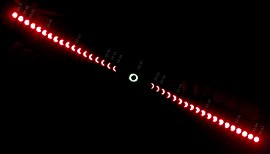
Photographing an eclipse is possible with fairly common photographic camera equipment. In gild for the disk of the Lord's day/Moon to be easily visible, a fairly high magnification long focus lens is needed (at to the lowest degree 200 mm for a 35 mm camera), and for the disk to make full virtually of the frame, a longer lens is needed (over 500 mm). Every bit with viewing the Sun directly, looking at it through the optical viewfinder of a camera can produce impairment to the retina, and so care is recommended.[81] Solar filters are required for digital photography even if an optical viewfinder is not used. Using a camera'south live view feature or an electronic viewfinder is rubber for the human eye, but the Sun'south rays could potentially irreparably harm digital image sensors unless the lens is covered by a properly designed solar filter.[82]
Other observations
A total solar eclipse provides a rare opportunity to observe the corona (the outer layer of the Sun's atmosphere). Ordinarily this is not visible considering the photosphere is much brighter than the corona. According to the betoken reached in the solar cycle, the corona may appear pocket-sized and symmetric, or large and fuzzy. It is very hard to predict this in accelerate.[83]
Equally the low-cal filters through leaves of trees during a partial eclipse, the overlapping leaves create natural pinholes, displaying mini eclipses on the ground.[84]
Phenomena associated with eclipses include shadow bands (also known every bit flight shadows), which are like to shadows on the bottom of a swimming puddle. They occur only but prior to and after totality, when a narrow solar crescent acts as an anisotropic low-cal source.[85]
1919 observations

The observation of a total solar eclipse of May 29, 1919, helped to confirm Einstein's theory of general relativity. By comparison the apparent distance between stars in the constellation Taurus, with and without the Lord's day between them, Arthur Eddington stated that the theoretical predictions about gravitational lenses were confirmed.[86] The observation with the Sun between the stars was possible merely during totality since the stars are then visible. Though Eddington'south observations were well-nigh the experimental limits of accuracy at the time, piece of work in the subsequently one-half of the 20th century confirmed his results.[87] [88]
Gravity anomalies
There is a long history of observations of gravity-related phenomena during solar eclipses, especially during the period of totality. In 1954, and once again in 1959, Maurice Allais reported observations of strange and unexplained movement during solar eclipses.[89] The reality of this phenomenon, named the Allais issue, has remained controversial. Similarly, in 1970, Saxl and Allen observed the sudden alter in motion of a torsion pendulum; this phenomenon is called the Saxl effect.[90]
Observation during the 1997 solar eclipse by Wang et al. suggested a possible gravitational shielding effect,[91] which generated argue. In 2002, Wang and a collaborator published detailed data analysis, which suggested that the phenomenon still remains unexplained.[92]
Eclipses and transits
In principle, the simultaneous occurrence of a solar eclipse and a transit of a planet is possible. But these events are extremely rare considering of their short durations. The next anticipated simultaneous occurrence of a solar eclipse and a transit of Mercury will be on July 5, 6757, and a solar eclipse and a transit of Venus is expected on Apr v, 15232.[93]
More common, but still infrequent, is a conjunction of a planet (peculiarly, but not only, Mercury or Venus) at the time of a total solar eclipse, in which event the planet will be visible very almost the eclipsed Lord's day, when without the eclipse information technology would take been lost in the Sun'southward glare. At ane time, some scientists hypothesized that there may exist a planet (oftentimes given the name Vulcan) even closer to the Sun than Mercury; the only style to confirm its beingness would have been to observe it in transit or during a total solar eclipse. No such planet was ever found, and full general relativity has since explained the observations that led astronomers to suggest that Vulcan might exist.[94]
Earthshine

From space, the Moon'south shadow during a solar eclipse appears as a dark spot moving across the World.
During a full solar eclipse, the Moon's shadow covers only a small fraction of the Earth. The Globe continues to receive at to the lowest degree 92 percentage of the amount of sunlight it receives without an eclipse – more if the penumbra of the Moon's shadow partly misses the Earth. Seen from the Moon, the Earth during a full solar eclipse is mostly brilliantly illuminated, with only a small dark patch showing the Moon's shadow. The brilliantly lit World reflects a lot of calorie-free to the Moon. If the corona of the eclipsed Sun were not present, the Moon, illuminated by earthlight, would exist easily visible from Earth. This would be essentially the same as the earthshine which can frequently exist seen when the Moon's stage is a narrow crescent. In reality, the corona, though much less vivid than the Sun'southward photosphere, is much brighter than the Moon illuminated by earthlight. Therefore, by dissimilarity, the Moon during a total solar eclipse appears to be black, with the corona surrounding it.
Artificial satellites


A composite image showing the ISS transit of the Sun while the 2017 solar eclipse was in progress.
Bogus satellites tin can also laissez passer in front of the Lord's day as seen from the World, but none is large enough to cause an eclipse. At the distance of the International Space Station, for example, an object would need to be most 3.35 km (ii.08 mi) across to blot the Sun out entirely. These transits are difficult to watch because the zone of visibility is very small. The satellite passes over the face of the Sun in about a second, typically. Every bit with a transit of a planet, it will not get nighttime.[95]
Observations of eclipses from spacecraft or bogus satellites orbiting in a higher place the Earth's atmosphere are not subject field to weather conditions. The coiffure of Gemini 12 observed a total solar eclipse from space in 1966.[96] The partial stage of the 1999 full eclipse was visible from Mir.[97]
During the Apollo–Soyuz Test Project conducted in July 1975, the Apollo spacecraft was positioned to create an bogus solar eclipse giving the Soyuz coiffure an opportunity to photo the solar corona.
Impact
The solar eclipse of March xx, 2015, was the first occurrence of an eclipse estimated to potentially have a pregnant impact on the ability system, with the electricity sector taking measures to mitigate any impact. The continental Europe and Great United kingdom synchronous areas were estimated to accept about ninety gigawatts of solar power and information technology was estimated that production would temporarily decrease by up to 34 GW compared to a clear sky solar day.[98] [99]
Eclipses may crusade the temperature to decrease by three °C, with current of air power potentially decreasing as winds are reduced past 0.7 yard/s.[100]
In add-on to the driblet in lite level and air temperature, animals change their behavior during totality. For example, birds and squirrels render to their nests and crickets chirp.[101]
Recent and forthcoming solar eclipses

Eclipse path for total and hybrid eclipses from 2021 to 2040.
Eclipses occur just in the eclipse season, when the Lord's day is close to either the ascending or descending node of the Moon. Each eclipse is separated past one, five or six lunations (synodic months), and the midpoint of each flavor is separated past 173.3 days, which is the hateful time for the Sun to travel from one node to the side by side. The period is a piddling less than half a calendar yr because the lunar nodes slowly regress. Because 223 synodic months is roughly equal to 239 anomalistic months and 242 draconic months, eclipses with like geometry recur 223 synodic months (about 6,585.iii days) apart. This flow (xviii years xi.three days) is a saros. Because 223 synodic months is not identical to 239 anomalistic months or 242 draconic months, saros cycles do not endlessly echo. Each cycle begins with the Moon'south shadow crossing the Earth near the northward or south pole, and subsequent events progress toward the other pole until the Moon's shadow misses the Earth and the series ends.[25] Saros cycles are numbered; currently, cycles 117 to 156 are active.
| 1997–2000 | 2000–2003 | 2004–2007 | 2008–2011 | 2011–2014 | 2015–2018 | 2018–2021 | 2022–2025 | 2026–2029 |
See also
- Lists of solar eclipses
- Eclipse chasing
- Lunar eclipse
- Occultation
- Solar eclipses in fiction
- Solar eclipses on the Moon
- Transit of Deimos from Mars
- Transit of Phobos from Mars
Notes
- ^ "What is an eclipse?". European Space Agency. Archived from the original on 2018-08-04. Retrieved 2018-08-04 .
- ^ a b Littmann, Marker; Espenak, Fred; Willcox, Ken (2008). Totality: Eclipses of the Lord's day. Oxford University Press. pp. 18–19. ISBN978-0-19-953209-4.
- ^ Five solar eclipses occurred in 1935.NASA (September 6, 2009). "Five Millennium Catalog of Solar Eclipses". NASA Eclipse Web Site. Fred Espenak, Projection and Website Manager. Archived from the original on April 29, 2010. Retrieved January 26, 2010.
- ^ Koukkos, Christina (May 14, 2009). "Eclipse Chasing, in Pursuit of Total Awe". The New York Times. Archived from the original on June 26, 2018. Retrieved January xv, 2012.
- ^ Pasachoff, Jay Yard. (July x, 2010). "Why I Never Miss a Solar Eclipse". The New York Times. Archived from the original on June 26, 2018. Retrieved January 15, 2012.
- ^ Harrington, pp. 7–8
- ^ "Eclipse: Who? What? Where? When? and How? | Total Solar Eclipse 2017". eclipse2017.nasa.gov. Archived from the original on 2017-09-eighteen. Retrieved 2017-09-21 .
- ^ a b c d eastward Harrington, pp. nine–11
- ^ "Transit of Venus, Sun–Earth Day 2012". nasa.gov. Archived from the original on January 14, 2016. Retrieved February 7, 2016.
- ^ "Solar Eclipses". University of Tennessee. Archived from the original on June ix, 2015. Retrieved Jan fifteen, 2012.
- ^ "How Is the Sun Completely Blocked in an Eclipse?". NASA Infinite Place. NASA. 2009. Archived from the original on 2021-01-nineteen. Retrieved 2019-09-01 .
- ^ Espenak, Fred (September 26, 2009). "Solar Eclipses for Beginners". MrEclipse.com. Archived from the original on May 24, 2015. Retrieved January 15, 2012.
- ^ Steel, p. 351
- ^ a b Espenak, Fred (Jan 6, 2009). "Central Solar Eclipses: 1991–2050". NASA Eclipse web site. Greenbelt, MD: NASA Goddard Space Flying Centre. Archived from the original on January 8, 2021. Retrieved January 15, 2012.
- ^ Verbelen, Felix (November 2003). "Solar Eclipses on Earth, 1001 BC to AD 2500". online.be. Archived from the original on August 3, 2019. Retrieved Jan 15, 2012.
- ^ Harrington, pp. thirteen–14; Steel, pp. 266–279
- ^ Mobberley, pp. 30–38
- ^ a b c Harrington, pp. four–5
- ^ Hipschman, Ron. "Why Eclipses Happen". Exploratorium. Archived from the original on December 27, 2015. Retrieved January 14, 2012.
- ^ Brewer, Bryan (Jan 14, 1998). "What Causes an Eclipse?". Earth View. Archived from the original on January ii, 2013. Retrieved January fourteen, 2012.
- ^ NASA – Eclipse 99 – Frequently Asked Questions Archived 2010-05-27 at the Wayback Machine – There is a fault in the How long will we proceed to be able to see full eclipses of the Sun? answer, "...the Lord's day's athwart bore varies from 32.7 minutes of arc when the Earth is at its farthest bespeak in its orbit (aphelion), and 31.vi arc minutes when it is at its closest (perihelion)." It should announced smaller when farther, so the values should be swapped.
- ^ Steel, pp. 319–321
- ^ Steel, pp. 317–319
- ^ Harrington, pp. 5–vii
- ^ a b Espenak, Fred (August 28, 2009). "Periodicity of Solar Eclipses". NASA Eclipse web site. Greenbelt, MD: NASA Goddard Infinite Flying Eye. Archived from the original on November 12, 2020. Retrieved January xv, 2012.
- ^ Espenak, Fred; Meeus, Jean (January 26, 2007). "Five Millennium Catalog of Solar Eclipses: -1999 to +3000". NASA Eclipse web site. Greenbelt, MD: NASA Goddard Infinite Flight Center. Archived from the original on October 24, 2020. Retrieved Jan 15, 2012.
- ^ European Infinite Bureau, "Spacecraft flight dynamics Archived 2019-12-11 at the Wayback Machine: proceedings of an international symposium, eighteen–22 May 1981-Darmstadt, Germany", p.347
- ^ Mobberley, pp. 33–37
- ^ "How do eclipses such as the one on Wednesday 14 Nov 2012 occur?". Sydney Observatory. Archived from the original on 29 April 2013. Retrieved 20 March 2015.
- ^ Steel, pp. 52–53
- ^ Seidelmann, P. Kenneth; Urban, Sean E., eds. (2013). Explanatory Supplement to the Astronomical Almanac (3rd ed.). University Science Books. ISBN978-1-891389-85-6.
- ^ a b c d Meeus, J. (December 2003). "The maximum possible duration of a total solar eclipse". Periodical of the British Astronomical Association. 113 (half dozen): 343–348. Bibcode:2003JBAA..113..343M.
- ^ 1000. Littman, et al.
- ^ Espenak, Fred (March 24, 2008). "World Atlas of Solar Eclipse Paths". NASA Eclipse web site. NASA Goddard Space Flight Center. Archived from the original on July 14, 2012. Retrieved Jan 15, 2012.
- ^ Steel, p. 4
- ^ For 360 years, run across Harrington, p. nine; for 410 years, come across Steel, p. 31
- ^ Mobberley, pp. 33–36; Steel, p. 258
- ^ Beckman, J.; Begot, J.; Charvin, P.; Hall, D.; Lena, P.; Soufflot, A.; Liebenberg, D.; Wraight, P. (1973). "Eclipse Flying of Concorde 001". Nature. 246 (5428): 72–74. Bibcode:1973Natur.246...72B. doi:ten.1038/246072a0. S2CID 10644966.
- ^ Stephenson, F. Richard (1997). Historical Eclipses and Earth'southward Rotation. Cambridge University Printing. p. 54. doi:10.1017/CBO9780511525186. ISBN0-521-46194-4. Archived from the original on 2020-08-01. Retrieved 2012-01-04 .
- ^ Mobberley, p. 10
- ^ Espenak, Fred (August 28, 2009). "Eclipses and the Saros". NASA Eclipse spider web site. NASA Goddard Space Flying Eye. Archived from the original on May 24, 2012. Retrieved Jan 15, 2012.
- ^ Pogo, Alexander (1935). "Calendar years with five solar eclipses". Popular Astronomy. Vol. 43. p. 412. Bibcode:1935PA.....43..412P.
- ^ "What are solar eclipses and how often exercise they occur?". timeanddate.com. Archived from the original on 2017-02-02. Retrieved 2014-xi-23 .
- ^ a b Walker, John (July 10, 2004). "Moon near Perigee, World near Aphelion". Fourmilab. Archived from the original on December 8, 2013. Retrieved March vii, 2010.
- ^ Mayo, Lou. "WHAT'South UP? The Very Terminal Solar Eclipse!". NASA. Archived from the original on 2017-08-22. Retrieved 22 August 2017.
- ^ Acta Eruditorum. Leipzig. 1762. p. 168. Archived from the original on 2020-07-31. Retrieved 2018-06-06 .
- ^ van Gent, Robert Harry. "Astronomical Chronology". University of Utrecht. Archived from the original on July 28, 2020. Retrieved January 15, 2012.
- ^ Humphreys, Colin; Waddington, Graeme (2017). "Solar eclipse of 1207 BC helps to date pharaohs". Astronomy and Geophysics. 58 (five): 5.39–5.42. Bibcode:2017A&Chiliad....58e5.39H. doi:x.1093/astrogeo/atx178.
- ^ Harrington, p. 2
- ^ Blakeslee, Sandra (November 14, 2006). "Aboriginal Crash, Ballsy Wave". The New York Times. Archived from the original on April eleven, 2009. Retrieved November xiv, 2006.
- ^ Steel, p. i
- ^ Steel, pp. 84–85
- ^ Le Conte, David (December half dozen, 1998). "Eclipse Quotations". MrEclipse.com. Archived from the original on October 17, 2020. Retrieved January viii, 2011.
- ^ Herodotus. Book VII. p. 37. Archived from the original on 2008-08-19. Retrieved 2008-07-13 .
- ^ Chambers, M. F. (1889). A Handbook of Descriptive and Practical Astronomy. Oxford: Clarendon Press. p. 323.
- ^ a b c d e Espenak, Fred. "Solar Eclipses of Historical Interest". NASA Eclipse spider web site. NASA Goddard Infinite Flight Heart. Archived from the original on March 9, 2008. Retrieved December 28, 2011.
- ^ Herodotus. Book IX. p. ten. Archived from the original on 2020-07-26. Retrieved 2008-07-xiv .
- ^ Schaefer, Bradley East. (May 1994). "Solar Eclipses That Inverse the Globe". Sky & Telescope. Vol. 87, no. 5. pp. 36–39. Bibcode:1994S&T....87...36S.
- ^ a b c d e Stephenson, F. Richard (1982). "Historical Eclipses". Scientific American. Vol. 247, no. 4. pp. 154–163. Bibcode:1982SciAm.247d.154S.
- ^ Needham, Joseph (1986). Scientific discipline and Civilization in Cathay: Volume 3. Taipei: Caves Books. pp. 411–413. OCLC 48999277.
- ^ Humphreys, C. J.; Waddington, Westward. Thou. (1983). "Dating the Crucifixion". Nature. 306 (5945): 743–746. Bibcode:1983Natur.306..743H. doi:10.1038/306743a0. S2CID 4360560.
- ^ Kidger, Marking (1999). The Star of Bethlehem: An Astronomer's View. Princeton, NJ: Princeton University Printing. pp. 68–72. ISBN978-0-691-05823-8.
- ^ Ó Cróinín, Dáibhí. "Reeling in the years: why 664 AD was a terrible yr in Ireland". rte.ie. Archived from the original on 2021-01-08. Retrieved January 9, 2021.
- ^ Regis Morelon (1996). "General survey of Arabic astronomy". In Roshdi Rashed (ed.). Encyclopedia of the History of Arabic Science. Vol. I. Routledge. p. 15.
- ^ Fiske, John (October i, 1997). Myths and Myth-Makers Old Tales and Superstitions Interpreted by Comparative Mythology. Project Gutenberg. Archived from the original on July 26, 2020. Retrieved February 12, 2017.
- ^ Espenak, Fred (July 11, 2005). "Eye Safe During Solar Eclipses". NASA Eclipse web site. NASA Goddard Space Flight Middle. Archived from the original on July 16, 2012. Retrieved January 15, 2012.
- ^ Dobson, Roger (August 21, 1999). "UK hospitals assess eye damage after solar eclipse". British Medical Journal. 319 (7208): 469. doi:10.1136/bmj.319.7208.469. PMC1116382. PMID 10454393.
- ^ MacRobert, Alan M. (viii August 2006). "How to Lookout man a Partial Solar Eclipse Safely". Sky & Telescope . Retrieved August 4, 2007.
- ^ Chou, B. Ralph (July xi, 2005). "Eye rubber during solar eclipses". NASA Eclipse web site. NASA Goddard Space Flying Center. Archived from the original on November 14, 2020. Retrieved January 15, 2012.
- ^ Littmann, Mark; Willcox, Ken; Espenak, Fred (1999). "Observing Solar Eclipses Safely". MrEclipse.com. Archived from the original on July 26, 2020. Retrieved January xv, 2012.
- ^ Chou, B. Ralph (January 20, 2008). "Eclipse Filters". MrEclipse.com. Archived from the original on Nov 27, 2020. Retrieved Jan iv, 2012.
- ^ a b "Solar Viewing Prophylactic". Perkins Observatory. Archived from the original on July 14, 2020. Retrieved Jan 15, 2012.
- ^ a b Harrington, p. 25
- ^ Harrington, p. 26
- ^ Harrington, p. 40
- ^ a b Littmann, Mark; Willcox, Ken; Espenak, Fred (1999). "The Feel of Totality". MrEclipse.com. Archived from the original on February 4, 2012. Retrieved January 15, 2012.
- ^ Kate Russo (1 August 2012). Total Habit: The Life of an Eclipse Chaser. Springer Scientific discipline & Business Media. ISBN978-three-642-30481-1. Archived from the original on 9 December 2019. Retrieved 24 Baronial 2017.
- ^ Kelly, Pat (2017-07-06). "Umbraphile, Umbraphilia, Umbraphiles, and Umbraphiliacs - Solar Eclipse with the Sol Brotherhood". Solar Eclipse with the Sol Alliance. Archived from the original on 2019-08-13. Retrieved 2017-08-24 .
- ^ "How to View the 2017 Solar Eclipse Safely". eclipse2017.nasa.gov. Archived from the original on 2017-08-24. Retrieved 2017-08-24 .
- ^ Wright, Andy (2017-08-16). "Chasing Totality: A Look Into the World of Umbraphiles". Atlas Obscura. Archived from the original on 2020-12-xiv. Retrieved 2017-08-24 .
- ^ Kramer, Neb. "Photographing a Total Solar Eclipse". Eclipse-chasers.com. Archived from the original on Jan 29, 2009. Retrieved March seven, 2010.
- ^ Vorenkamp, Todd (April 2017). "How to Photograph a Solar Eclipse". B&H Photo Video. Archived from the original on July 1, 2019. Retrieved August nineteen, 2017.
- ^ "The science of eclipses". ESA. September 28, 2004. Archived from the original on August 1, 2012. Retrieved August 4, 2007.
- ^ Johnson-Groh, Mara (10 August 2017). "V Tips from NASA for Photographing the Total Solar Eclipse on Aug. 21". NASA. Archived from the original on eighteen August 2020. Retrieved 21 September 2017.
- ^ Dravins, Dainis. "Flight Shadows". Lund Observatory. Archived from the original on July 26, 2020. Retrieved January 15, 2012.
- ^ Dyson, F.W.; Eddington, A.S.; Davidson, C.R. (1920). "A Determination of the Deflection of Light by the Sunday'southward Gravitational Field, from Observations Fabricated at the Solar eclipse of May 29, 1919". Phil. Trans. Roy. Soc. A. 220 (571–81): 291–333. Bibcode:1920RSPTA.220..291D. doi:10.1098/rsta.1920.0009. Archived from the original on November 3, 2020. Retrieved August 27, 2019.
- ^ "Relativity and the 1919 eclipse". ESA. September 13, 2004. Archived from the original on October 21, 2012. Retrieved January 11, 2011.
- ^ Steel, pp. 114–120
- ^ Allais, Maurice (1959). "Should the Laws of Gravitation exist Reconsidered?". Aero/Space Engineering science. 9: 46–55.
- ^ Saxl, Erwin J.; Allen, Mildred (1971). "1970 solar eclipse as 'seen' past a torsion pendulum". Physical Review D. three (four): 823–825. Bibcode:1971PhRvD...3..823S. doi:x.1103/PhysRevD.iii.823.
- ^ Wang, Qian-shen; Yang, Xin-she; Wu, Chuan-zhen; Guo, Hong-gang; Liu, Hong-chen; Hua, Chang-chai (2000). "Precise measurement of gravity variations during a total solar eclipse". Physical Review D. 62 (4): 041101(R). arXiv:1003.4947. Bibcode:2000PhRvD..62d1101W. doi:10.1103/PhysRevD.62.041101. S2CID 6846335.
- ^ Yang, X. S.; Wang, Q. Due south. (2002). "Gravity anomaly during the Mohe total solar eclipse and new constraint on gravitational shielding parameter". Astrophysics and Infinite Scientific discipline. 282 (i): 245–253. Bibcode:2002Ap&SS.282..245Y. doi:x.1023/A:1021119023985. S2CID 118497439.
- ^ Meeus, J.; Vitagliano, A. (2004). "Simultaneous transits" (PDF). J. Br. Astron. Assoc. 114 (3): 132–135. Bibcode:2004JBAA..114..132M. Archived from the original (PDF) on July 10, 2007.
- ^ Grego, Peter (2008). Venus and Mercury, and How to Observe Them. Springer. p. iii. ISBN978-0387742854.
- ^ "ISS-Venustransit". astronomie.info (in German language). Archived from the original on 2020-07-28. Retrieved 2004-07-29 .
- ^ "JSC Digital Epitome Collection". NASA Johnson Space Heart. Jan xi, 2006. Archived from the original on February 4, 2012. Retrieved January fifteen, 2012.
- ^ Nemiroff, R.; Bonnell, J., eds. (August 30, 1999). "Looking Back on an Eclipsed Earth". Astronomy Picture of the 24-hour interval. NASA. Retrieved Jan fifteen, 2012.
- ^ "Solar Eclipse 2015 – Touch on Assay Archived 2017-02-21 at the Wayback Auto" pp. 3, half-dozen–seven, 13. European Network of Transmission System Operators for Electricity, 19 Feb 2015. Accessed: 4 March 2015.
- ^ "Curve of potential power loss". ing.dk. Archived from the original on 2020-07-28. Retrieved 2015-03-04 .
- ^ Gray, S. Fifty.; Harrison, R. One thousand. (2012). "Diagnosing eclipse-induced wind changes". Proceedings of the Imperial Society. 468 (2143): 1839–1850. Bibcode:2012RSPSA.468.1839G. doi:10.1098/rspa.2012.0007. Archived from the original on 2015-03-04. Retrieved 2015-03-04 .
- ^ Young, Alex. "How Eclipses Work". NASA. Archived from the original on 2017-09-eighteen. Retrieved 21 September 2017.
References
- Mucke, Hermann; Meeus, Jean (1992). Canon of Solar Eclipses -2003 to +2526 (2 ed.). Vienna: Astronomisches Büro.
- Harrington, Philip S. (1997). Eclipse! The What, Where, When, Why and How Guide to Watching Solar and Lunar Eclipses. New York: John Wiley and Sons. ISBN0-471-12795-seven.
- Steel, Duncan (1999). Eclipse: The celestial phenomenon which has inverse the class of history. London: Headline. ISBN0-7472-7385-5.
- Mobberley, Martin (2007). Total Solar Eclipses and How to Observe Them. Astronomers' Observing Guides. New York: Springer. ISBN978-0-387-69827-four.
- Espenak, Fred (2015). G Year Catechism of Solar Eclipses 1501 to 2500. Portal AZ: Astropixels Publishing. ISBN978-one-941983-02-7.
- Espenak, Fred (2016). 21st Century Canon of Solar Eclipses. Portal AZ: Astropixels Publishing. ISBN978-i-941983-12-half-dozen.
- Fotheringham, John Knight (1921). Historical eclipses: beingness the Halley lecture delivered 17 May 1921. Oxford: Clarendon Press.
External links

- NASA Eclipse Web Site
- Eclipsewise, Fred Espenak's new eclipse site
- Andrew Lowe'south Eclipse Page, with maps and circumstances for 5000 years of solar eclipses
- Detailed eclipse explanations and predictions, Hermit Eclipse
- Eclipse Photography, Prof. Miroslav Druckmüller
- Animated maps of August 21, 2017 solar eclipses, Larry Koehn
- 5 Millennium (−1999 to +3000) Canon of Solar Eclipses Database, Xavier 1000. Jubier
- Animated caption of the mechanics of a solar eclipse Archived 2013-05-25 at the Wayback Car, Academy of S Wales
- Eclipse Image Gallery Archived 2016-10-15 at the Wayback Machine, The World at Night
- Ring of Burn Eclipse: 2012, Photos
- . Collier'south New Encyclopedia. 1921.
- Centered and aligned video recording of Total Solar Eclipse 20th March 2015 on YouTube
- Solar eclipse photographs taken from the Lick Observatory from the Lick Observatory Records Digital Archive, UC Santa Cruz Library's Digital Collections Archived 2020-06-05 at the Wayback Car
- Video with Full Solar Eclipse March 09 2016 (From the Beginning to the Total Phase) on YouTube
- Total Solar Eclipse Shadow on Globe March 09 2016 CIMSSSatelite
- List of all solar eclipses
- National Geographic Solar Eclipse 101 video Archived 2018-08-04 at the Wayback Motorcar
-
 Wikiversity has a solar eclipse lab that students tin practice on any sunny day.
Source: https://en.wikipedia.org/wiki/Solar_eclipse
0 Response to "what phase must be moon be for earth to have a chance to see a solar eclipse?"
Postar um comentário