Make Button Call Javasript Funciton Again
Whenever y'all visit a website, you'll probably click on something like a link or button.
Links accept you to a sure part of the folio, another folio of the website, or some other website entirely. Buttons, on the other hand, are usually manipulated by JavaScript events then they tin trigger sure functionality.
In this tutorial, we are going to explore the two different ways of executing click events in JavaScript using two dissimilar methods.
First, we'll wait at the traditional onclick way that you do right from the HTML page. Then we'll see how the more mod "click" eventListner works, which lets you lot separate the HTML from the JavaScript.
How to Utilize the onclick consequence in JavaScript
The onclick result executes a certain functionality when a push is clicked. This could be when a user submits a grade, when yous modify certain content on the spider web page, and other things like that.
You lot identify the JavaScript office yous desire to execute within the opening tag of the button.
Basic onclick syntax
<chemical element onclick="functionToExecute()">Click</chemical element> For case
<button onclick="functionToExecute()">Click</push button> Note that the onclick attribute is purely JavaScript. The value it takes, which is the function you want to execute, says information technology all, as it is invoked right inside the opening tag.
In JavaScript, you lot invoke a function by calling its name, then yous put a parenthesis afterwards the part identifier (the name).
onclick event example
I have prepared some basic HTML with a little bit of styling so nosotros can put the onclick effect into real-globe practice.
<div> <p form="name">freeCodeCamp</p> <button>Modify to Blue</push button> </div> And here's the CSS to make it look good, along with all the balance of the instance code:
trunk { brandish: flex; align-items: centre; justify-content: center; height: 100vh; } p { font-size: 2rem; } button { padding: 7px; border: none; border-radius: 4px; cursor: arrow; } push button.blue { background-color: #3498db; } button.light-green { background-colour: #2ecc71; } button.orange { background-color: orangered; } So, on the web page, this is what we have:
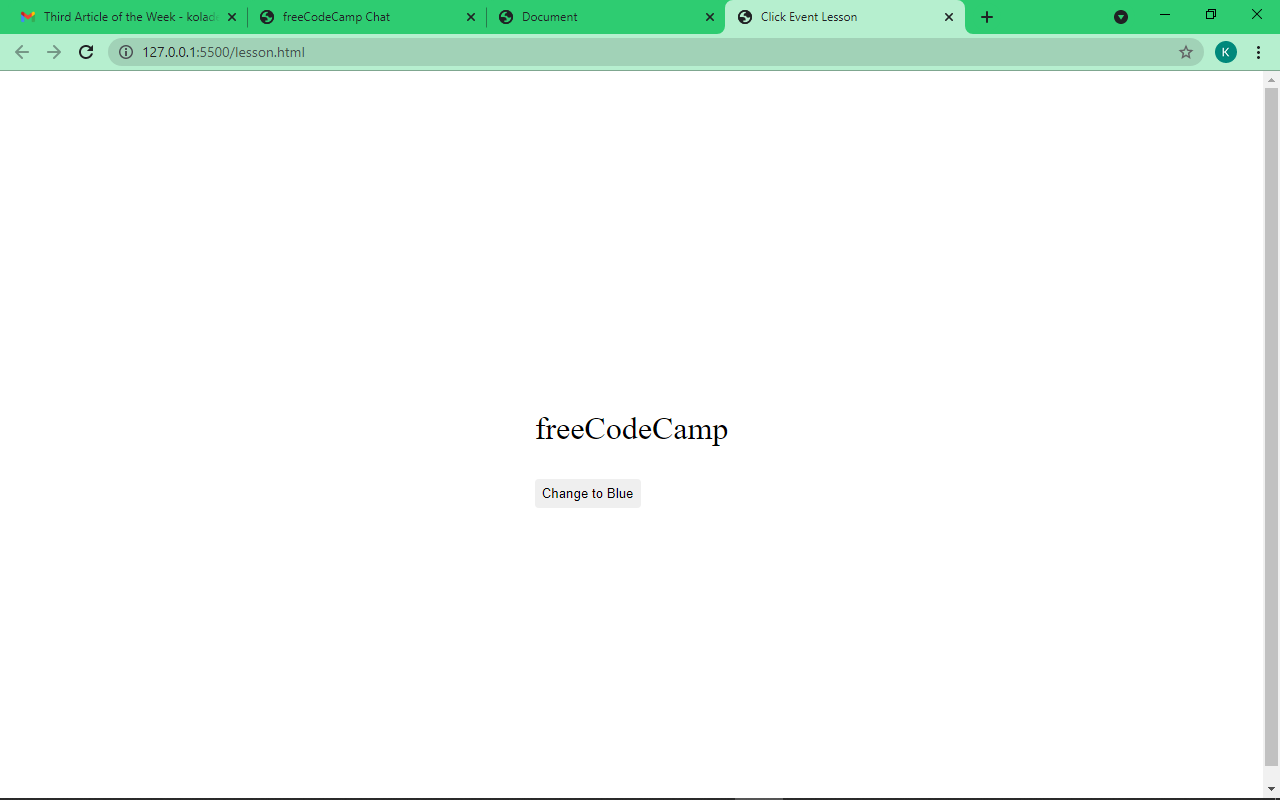
Our aim is to change the color of the text to blue when nosotros click the button. And so we need to add an onclick aspect to our button, and so write the JavaScript part to change the color.
And so we need to brand a slight change in our HTML:
<div> <p class="name">freeCodeCamp</p> <push onclick="changeColor()">Change to Blue</button> </div> The function we desire to execute is changeColor(). So we demand to write it in a JavaScript file, or in the HTML file inside a <script> tag.
If you desire to write your script in a JavaScript file, yous need to link information technology in the HTML using the syntax below:
<script src="path-to-javascript-file"></script> If you desire to write the script in an HTML file, simply put it within the script tag:
<script> // Your Scripts </script> Now, let's write our changeColor() office.
Showtime of all, we need to select the chemical element we want to manipulate, which is the freeCodeCamp text within the <p> tag.
In JavaScript, you do that with the DOM'due south getElementById(), getElementsByClassName(), or the querySelector() methods. Then you shop the value in a variable.
In this tutorial, I volition be using querySelector() because it is more than mod and it'due south faster. I volition likewise exist using const to declare our variables instead of let and var, because with const, things are safer as the variable becomes read-only.
const name = document.querySelector(".name"); At present that we have the text selected, permit'south write our function. In JavaScript, the basic function syntax looks similar this:
function funcctionName () { // What to do } So allow'south write our function:
function changeColor() { name.style.color = "blue"; } What's going on?
Call up from the HTML that changeColor() is the function we are going to execute. That's why our function identifier (name) is set up to changeColor. If the name doesn't correlate with what's in the HTML, it won't work.
In the DOM (Certificate Object Model, refers to all of the HTML), to change annihilation that relates to mode, you need to write "style" then a dot (.). This is followed by what you want to change, which might be the color, groundwork color, font size, and and then on.
So, inside our function, nosotros take the proper noun variable nosotros declared to get our freeCodeCamp text, so we change the colour to blue.
The colour of our the text turns blue any fourth dimension the button is clicked:
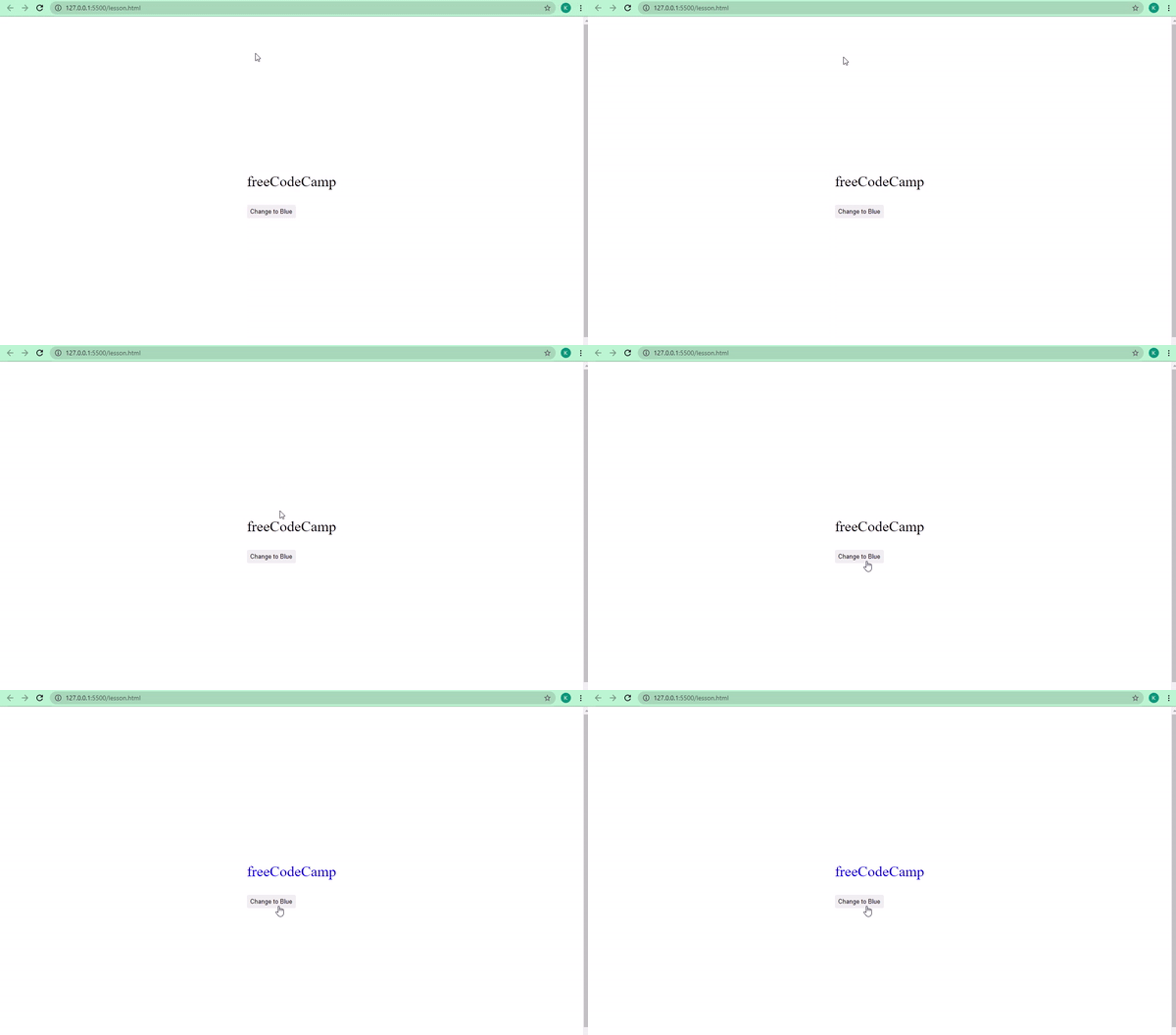
Our code is working!
We could take things a picayune chip further by irresolute our text to be more than colors:
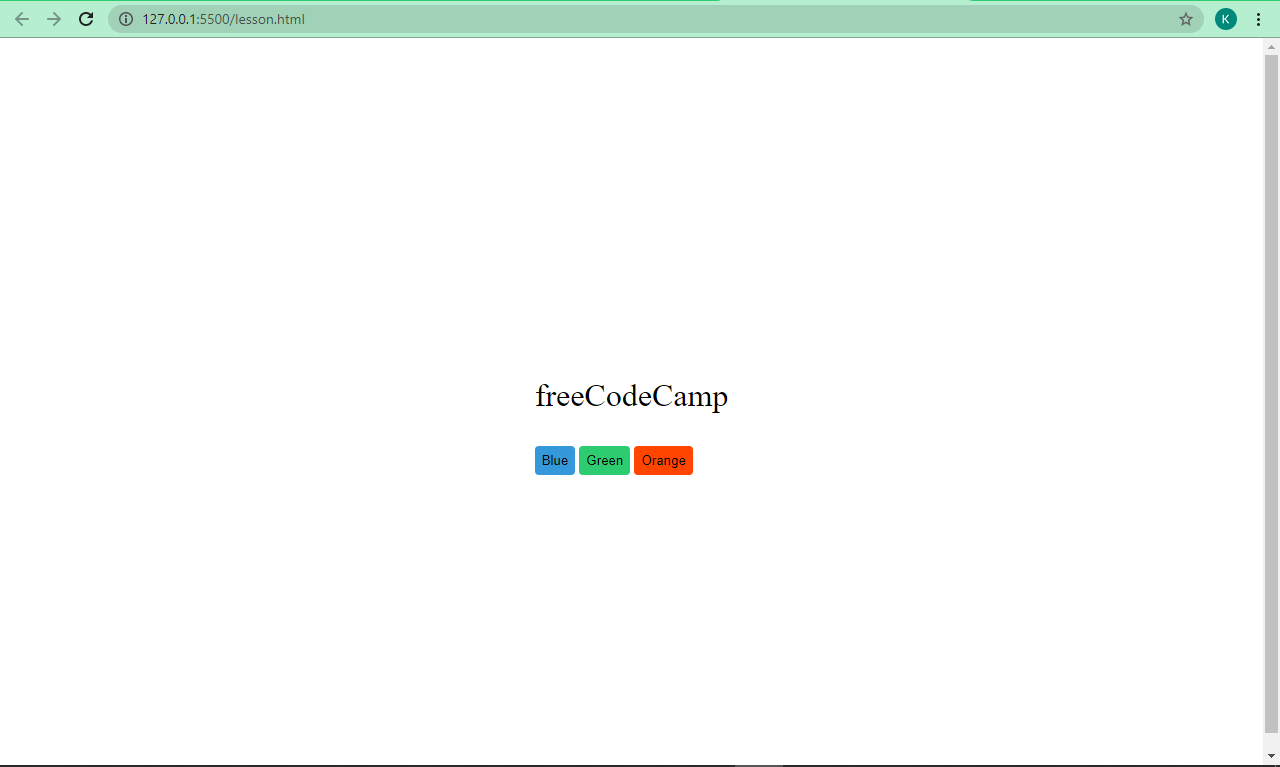
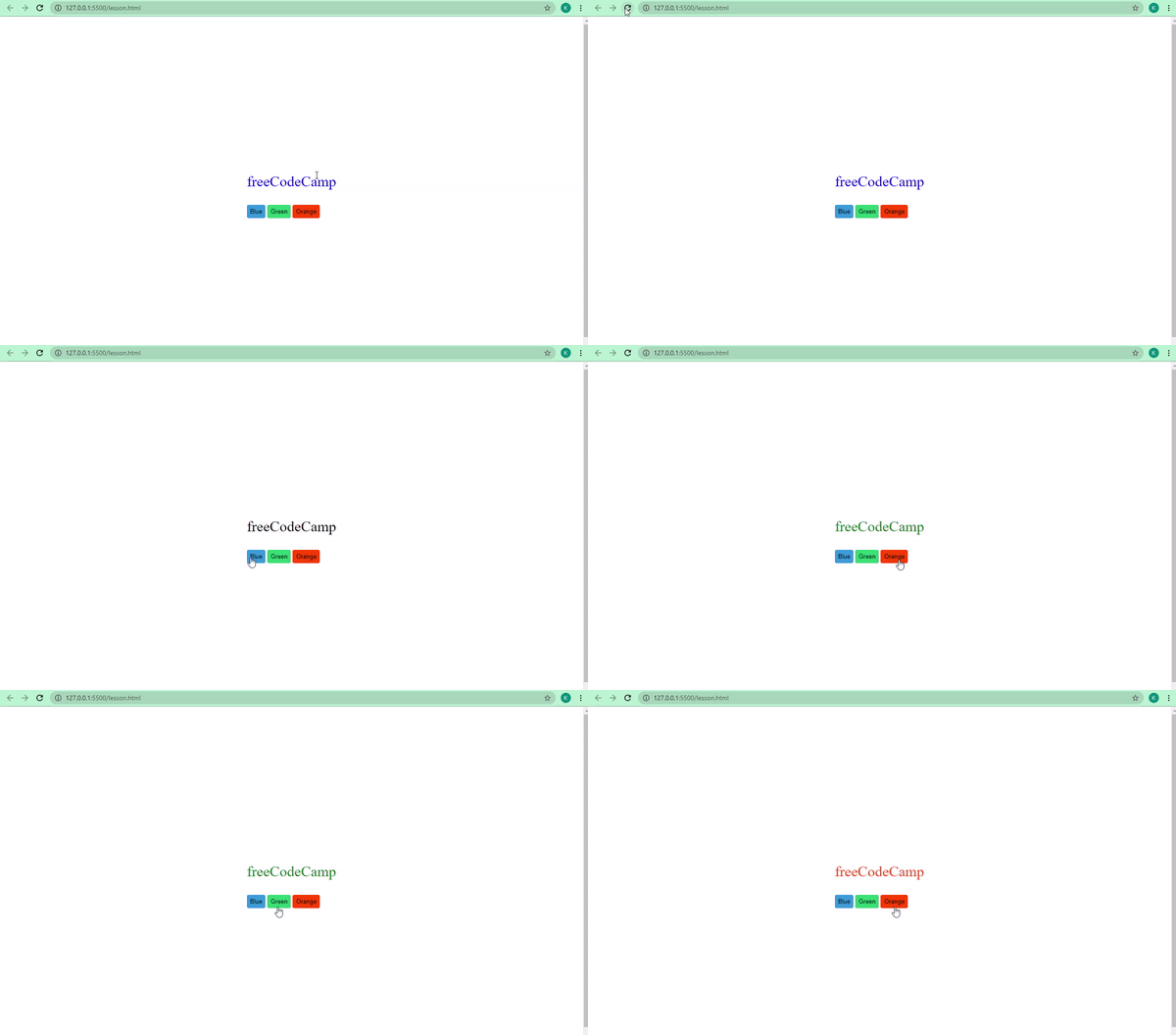
<div> <p class="name">freeCodeCamp</p> <push onclick="changeColor('bluish')" class="bluish">Blue</button> <button onclick="changeColor('green')" class="dark-green">Green</push> <button onclick="changeColor('orangered')" class="orange">Orange</button> </div> So, what we want to exercise is change the text to blue, green, and orange-red.
This time around, the onclick functions in our HTML take the values of the color nosotros want to modify the text to. These are called parameters in JavaScript. The function we'll write takes its ain too, which we will call "color".
Our web page changed a fiddling:
So, let'southward select our freeCodeCamp text and write the role to change its color to blue, light-green, and orange-ruby:
const proper noun = document.querySelector(".proper noun"); role changeColor(color) { name.style.colour = color; } The block of lawmaking in the office takes the name variable (where nosotros stored our freeCodeCamp text), then set the color to whatsoever nosotros passed into the changeColor() functions in the HTML buttons.
How to Utilise the click eventListener in JavaScript
In JavaScript, there are multiple means of doing the same affair. As JavaScript itself evolved over time, we started needing to separate the HTML, CSS, and JavaScript code in order to comply with all-time practices.
Event listeners make this possible as they let you lot separate the JavaScript from the HTML. Yous can likewise do this with onclick, but lets accept another approach here.
Bones eventListener syntax
element.addEventListener("type-of-event", functionToExecute) Now, let's alter the freeCodeCampt text to blue past using the click eventListner
This is our new HTML:
<div> <p class="name">freeCodeCamp</p> <button>Change Color</button> </div> And this is what it looks like:

This fourth dimension around in our script, we need to select the button too (not just the freeCodeCamp text). That's because there's zippo JavaScript in the opening tag of our push, which is cool.
And so, our script looks like this:
const name = document.querySelector(".name"); const btn = document.querySelector("push"); btn.addEventListener("click", role () { name.style.color = "blue"; }); We can also separate our function totally from the eventListener and our functionality will withal remain the same:
btn.addEventListener("click", changeColor); function changeColor() { name.style.color = "blueish"; } 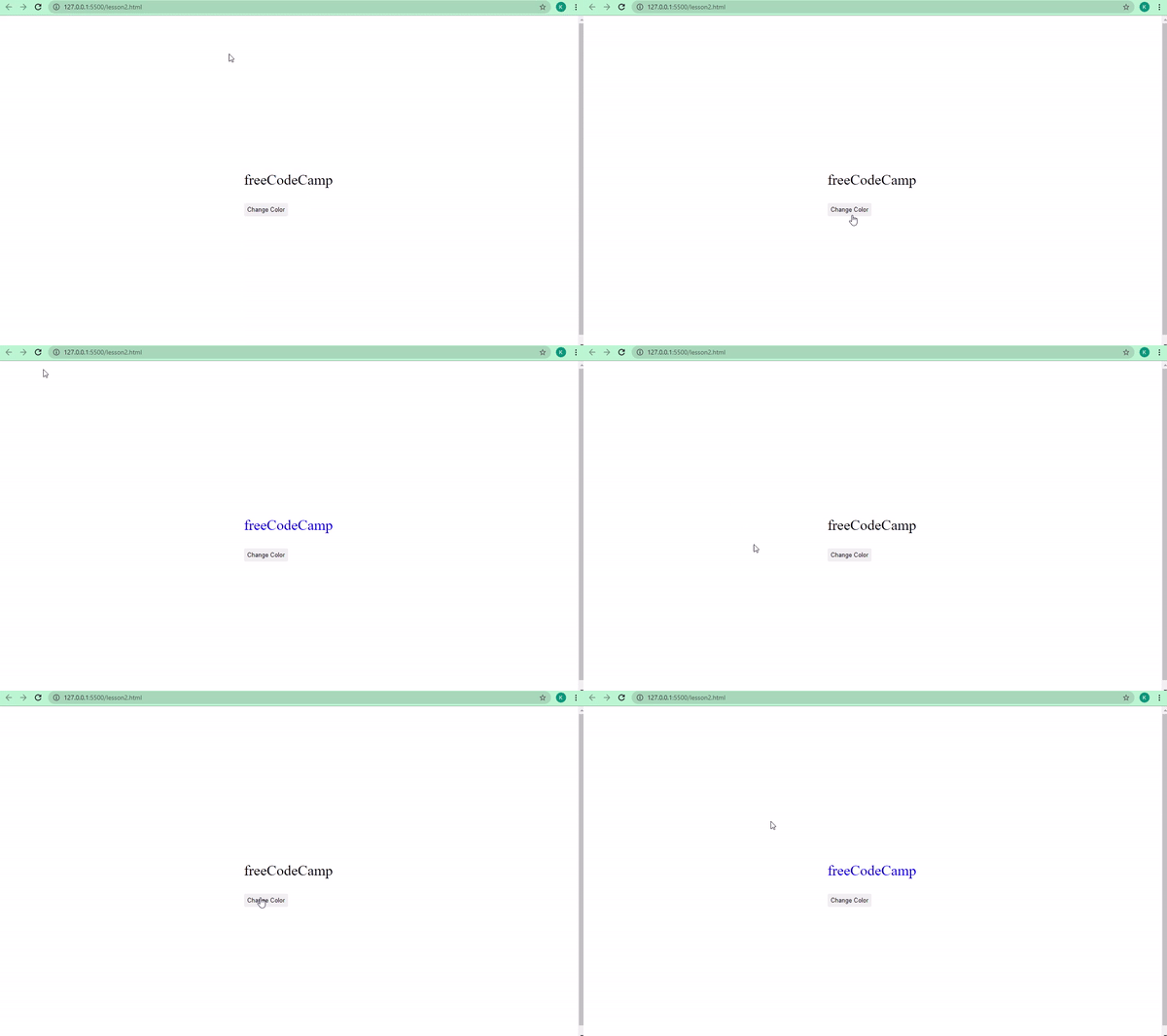
How to Build a " Bear witness More" and "Testify Less" Push button with JavaScrpit
One of the best ways to acquire is by making projects, so let'due south take what we've learned about the onclick and "click" eventListner to do build something.
When you visit a blog, yous often meet excerpts of manufactures first. Then you can click on a "read more" push button to evidence the rest. Let'south try to practise that.
This is the HTML we are dealing with:
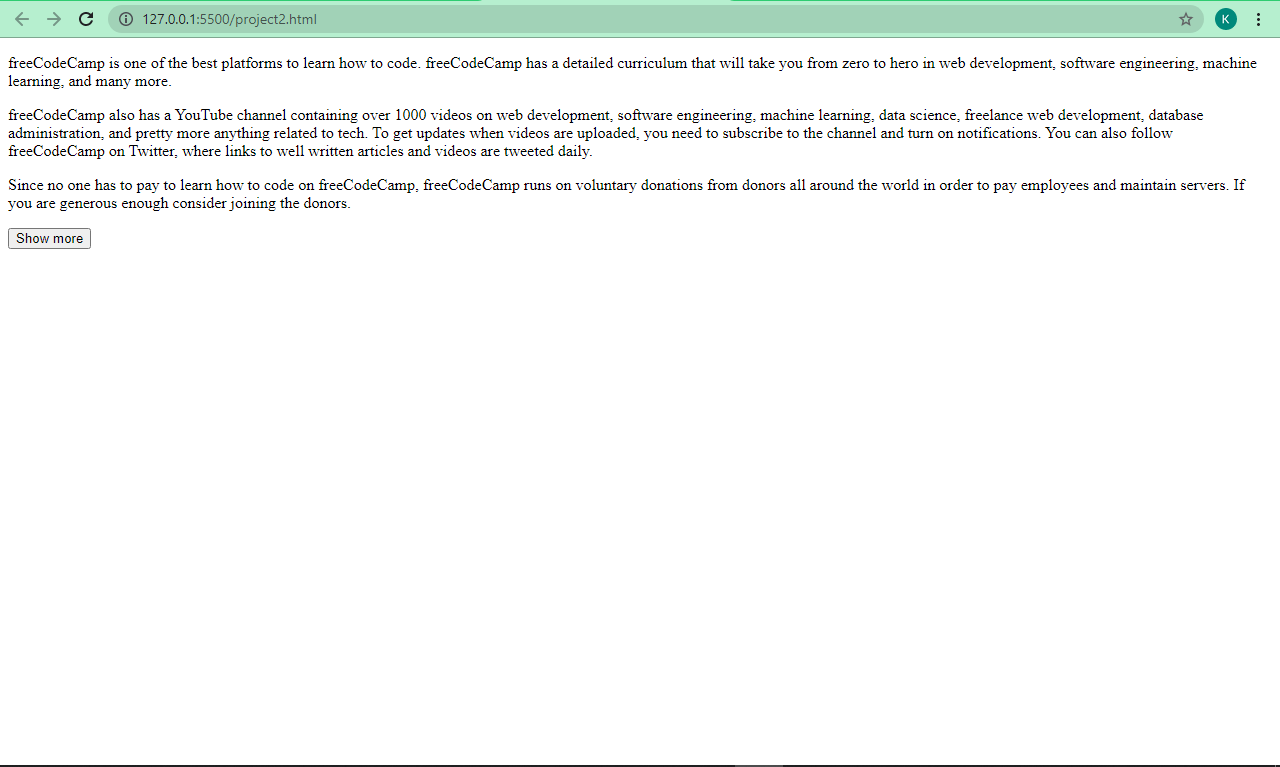
<article id="content"> <p> freeCodeCamp is 1 of the best platforms to learn how to code. freeCodeCamp has a detailed curriculum that will take y'all from zero to hero in spider web evolution, software engineering, machine learning, and more than. </p> <p> freeCodeCamp also has a YouTube aqueduct containing over 1000 videos on web development, software technology, machine learning, information science, freelance web development, database assistants, and pretty much annihilation related to tech. To go updates when videos are uploaded, you demand to subscribe to the channel and turn on notifications. Y'all can besides follow freeCodeCamp on Twitter, where links to well written articles and videos are tweeted daily. </p> <p> Since no i has to pay to learn how to code on freeCodeCamp, freeCodeCamp runs on voluntary donations from donors all around the world in club to pay employees and maintain servers. If y'all are generous enough consider joining the donors. </p> </article> <button onclick="showMore()">Bear witness more</button> It'due south simple HTML with some facts about freeCodeCamp. And there's a button we already attach an onclick to. The function we want to execute is showMore(), which we will write shortly.
Without a CSS, this is what we have:
It's non super ugly, but we can make it expect better and human activity the way nosotros want it to. So nosotros have some CSS which I will explicate below:
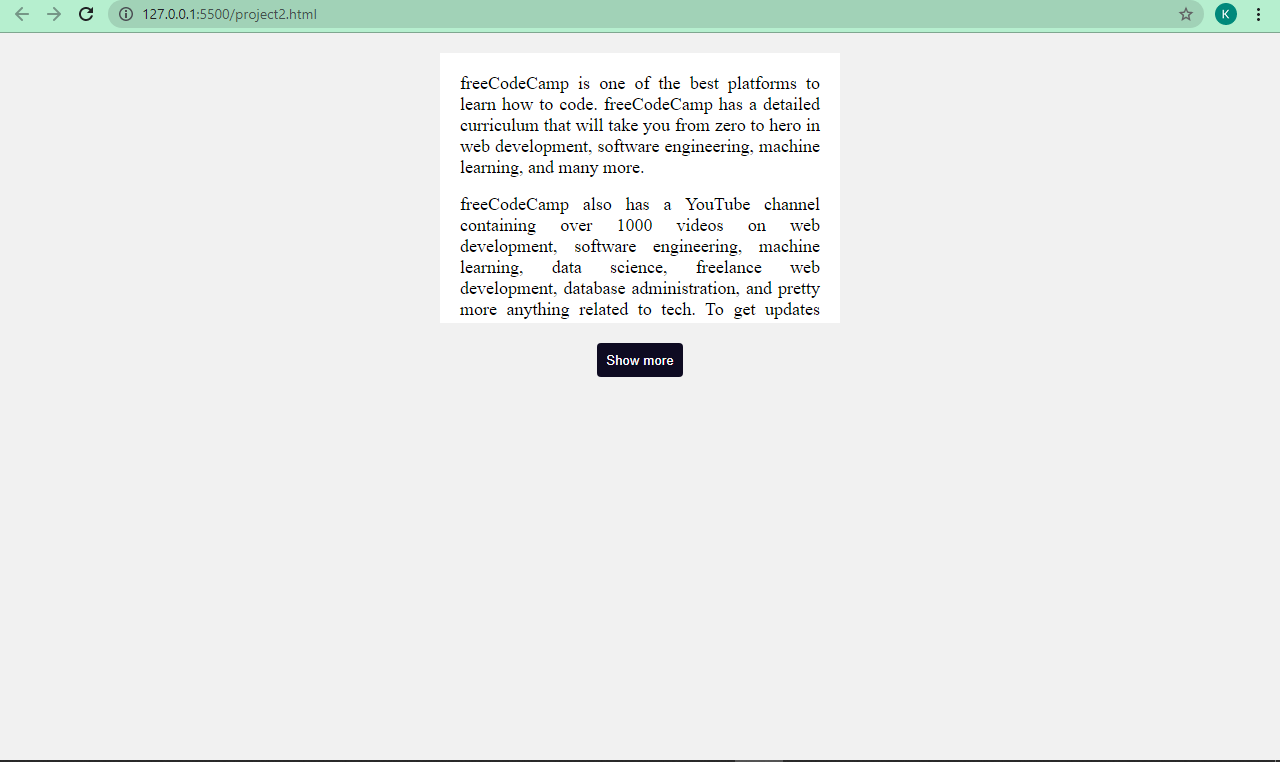
<style> * { margin: 0; padding: 0; box-sizing: border-box; } trunk { groundwork: #f1f1f1; display: flex; marshal-items: middle; justify-content: center; flex-direction: column; } article { width: 400px; background: #fff; padding: 20px 20px 0; font-size: 18px; max-height: 270px; overflow: subconscious; transition: max-height 1s; text-marshal: justify; margin-top: 20px; } p { margin-bottom: 16px; } article.open { max-height: 1000px; } button { groundwork: #0e0b22; color: #fff; padding: 0.6rem; margin-top: 20px; border: none; edge-radius: 4px; } button:hover { cursor: pointer; groundwork: #1e1d25; } </style> What's the CSS doing?
With the universal selector (*), we are removing the default margin and padding assigned to elements so we can add our own margin and padding.
We also have box sizing fix to edge-box and so we tin can include the padding and border in our elements' total width and top.
We centered everything in the body with Flexbox and gave information technology a calorie-free grey background.
Our <article> element, which contains the text, has a width of 400px, a white background (#fff), and has a padding of 20px at the summit, 20 on the left and right, and 0 at the bottom.
The paragraph tags inside of information technology have a font-size of 18px, and so we gave them a maximum tiptop of 270px. Due to the max height of the article element, all the text won't be contained and will overflow. To fix this, we fix overflow to hidden in order non to show that text at offset.
The transition belongings ensures that every change happens after one second. All text inside the commodity are justified and have a margin height of 20 pixels then it doesn't stay too attached to the top of the page.
Considering we removed the default margin, our paragraphs got all pushed together. So we fix a bottom margin of 16 pixels in order to carve up them from ane another.
Our selector, article.open, has a holding of max-top fix to 1000px. This means that whatsoever fourth dimension the article element has a grade of open fastened to it, the maximum superlative volition modify from 270px to 1000px to bear witness the rest of the article. This is possible with JavaScript – our game changer.
We styled our button with a darkish background and made it white. We prepare its border to none to remove HTML's default border on buttons, and nosotros gave it a border radius of 4px and so it has a slightly rounded border.
Finally, we used the hover pseudo-class in CSS to alter the button cursor to a pointer. The groundwork color slightly changes when a user hovers their cursor over information technology.
There we go – that'southward the CSS.
Our folio now looks amend:
The adjacent affair nosotros demand to practise is to write our JavaScript so nosotros tin encounter the rest of the article that is subconscious.
We have an onclick attribute inside our button opening tag ready to execute a showMore() function, so let's write the function.
We demand to select our article first, because we have to show the rest of it:
const commodity = certificate.querySelector("#content"); The next thing we need to practice is write the function showMore() so nosotros can toggle between seeing the rest of the article and hiding it.
function showMore() { if (article.className == "open") { // read less commodity.className = ""; button.innerHTML = "Show more"; } else { //read more article.className = "open"; push.innerHTML = "Evidence less"; } } What is the function doing?
We use an if…else statement here. This is a crucial part of JavaScript that helps you brand decisions in your code if a sure status is met.
The bones syntax looks like this:
if (condition == "something") { // Do something } else { // Exercise something else } Here, if the form name of the article equals open (that is, we desire to add the class of open up to it, which was set to a maximum summit of 1000px in the CSS), then we desire to come across the rest of the article. Else, we desire the commodity to return to the initial country where a office of it is hidden.
We exercise this by assigning it a form of open in the else block, which makes information technology show the balance of the article. Then we set the class to an empty string (none) in the if block, which makes information technology render to the initial state.
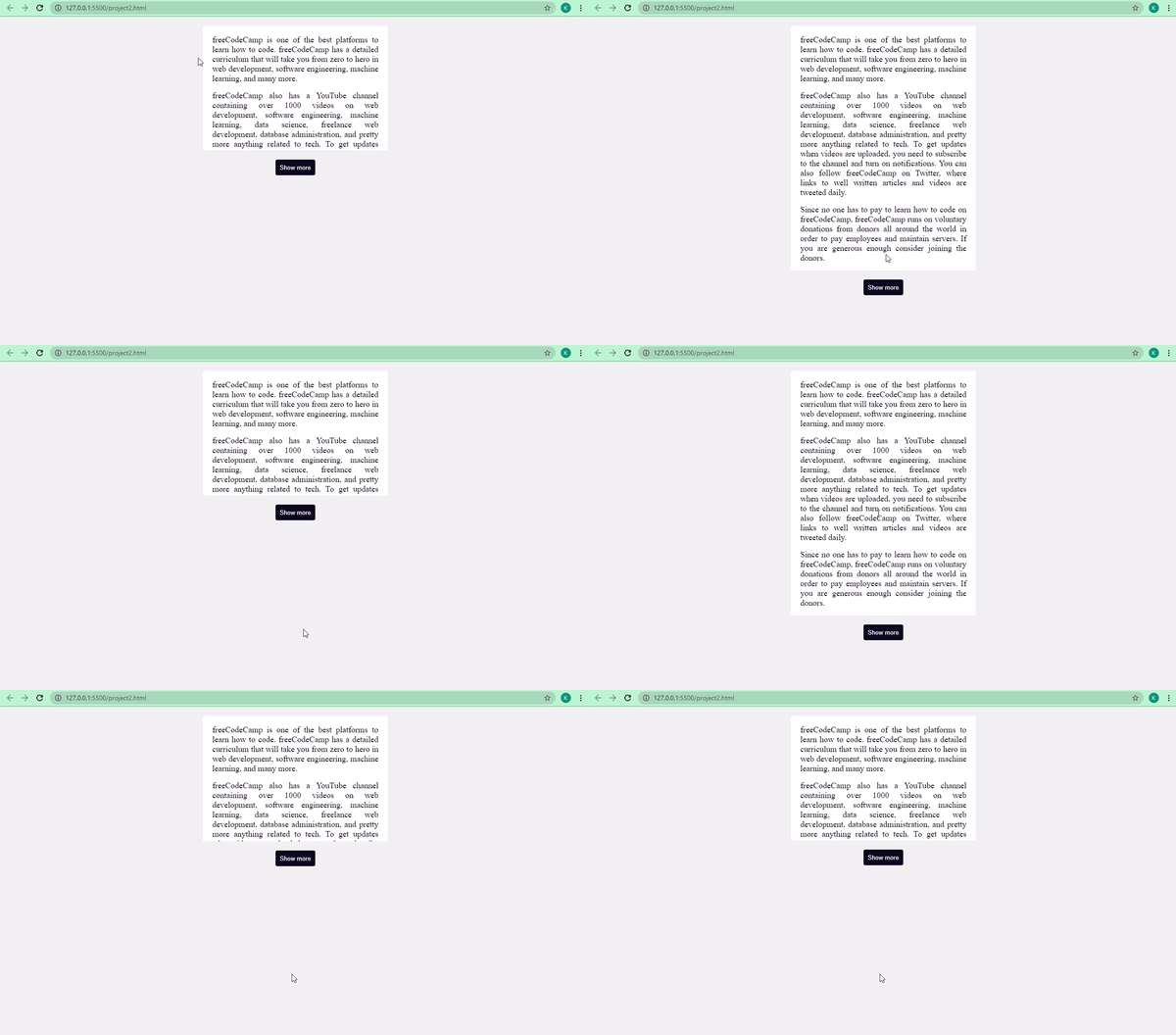
Our code is working fine with a smooth transition:
We can separate the HTML and JavaScript and still use onclick, considering onclick is JavaScript. So it'south possible to write this in a JavaScript file instead of starting from the HTML.
push button.onclick = function () { if (article.className == "open") { // read less article.className = ""; push button.innerHTML = "Bear witness more"; } else { //read more article.className = "open"; button.innerHTML = "Evidence less"; } }; 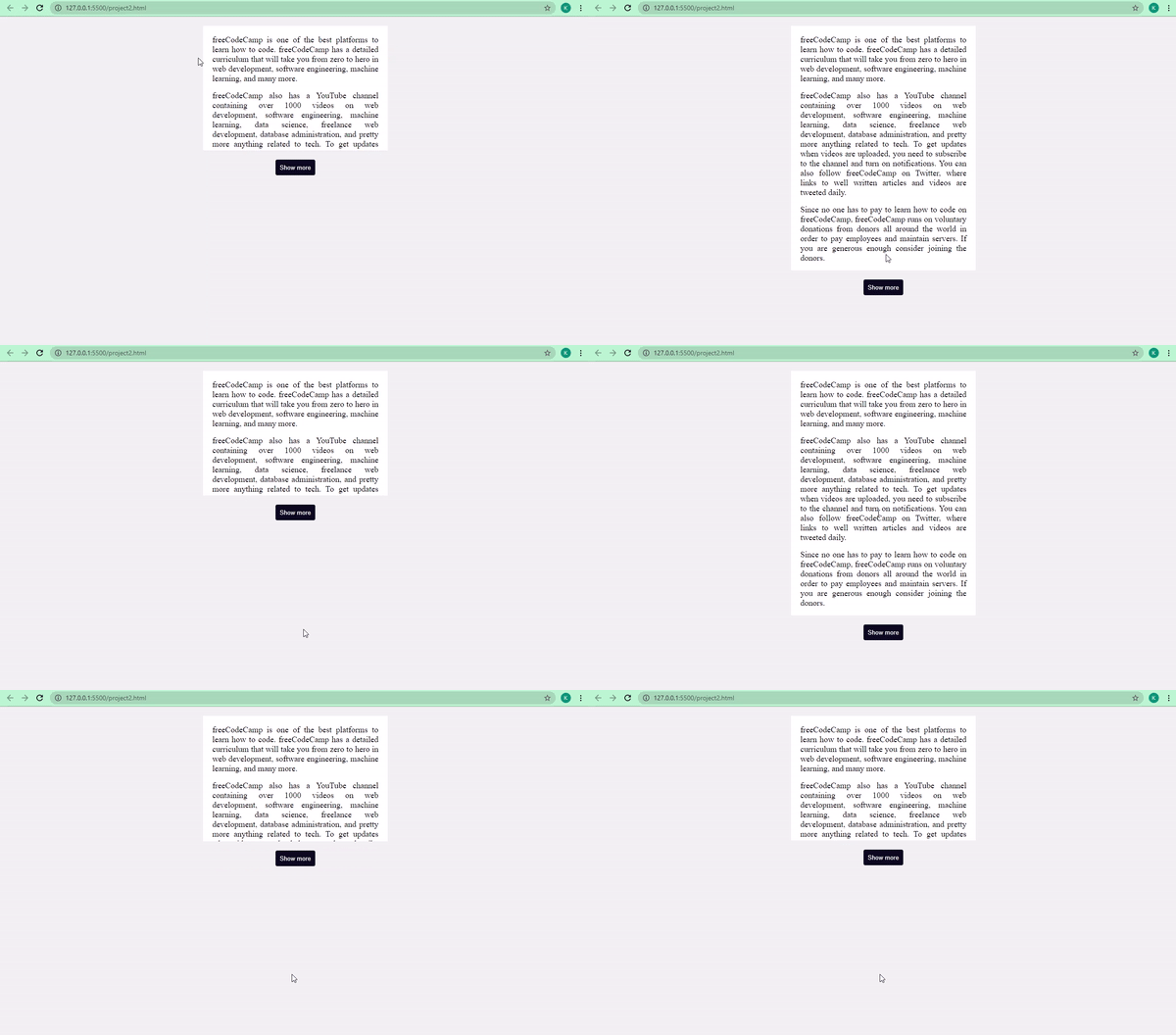
We can likewise practice this using an eventListner:
<article id="content"> <p> freeCodeCamp is one of the best platforms to larn how to code. freeCodeCamp has a detailed curriculum that will take you from goose egg to hero in spider web development, software engineering, machine learning, and many more. </p> <p> freeCodeCamp likewise has a YouTube aqueduct containing over 1000 videos on web development, software applied science, machine learning, information scientific discipline, freelance spider web development, database administration, and pretty more anything related to tech. To become updates when videos are uploaded, you need to subscribe to the channel and turn on notifications. You tin can also follow freeCodeCamp on Twitter, where links to well written articles and videos are tweeted daily. </p> <p> Since no one has to pay to learn how to code on freeCodeCamp, freeCodeCamp runs on voluntary donations from donors all effectually the world in club to pay employees and maintain servers. If you are generous enough consider joining the donors. </p> </article> <button id="read-more than">Evidence more than</push> const article = certificate.querySelector("#content"); const button = document.querySelector("#read-more"); push button.addEventListener("click", readMore); function readMore() { if (article.className == "open") { // Read less commodity.className = ""; button.innerHTML = "Prove more"; } else { article.className = "open up"; button.innerHTML = "Testify less"; } } Our functionality remains the same!
Determination
I hope this tutorial helps you understand how the click issue works in JavaScript. We explored two different methods here, so now yous tin start using them in your coding projects.
Thanks for reading, and keep coding.
Learn to lawmaking for free. freeCodeCamp'south open up source curriculum has helped more than than forty,000 people get jobs as developers. Get started
Source: https://www.freecodecamp.org/news/html-button-onclick-javascript-click-event-tutorial/
0 Response to "Make Button Call Javasript Funciton Again"
Postar um comentário